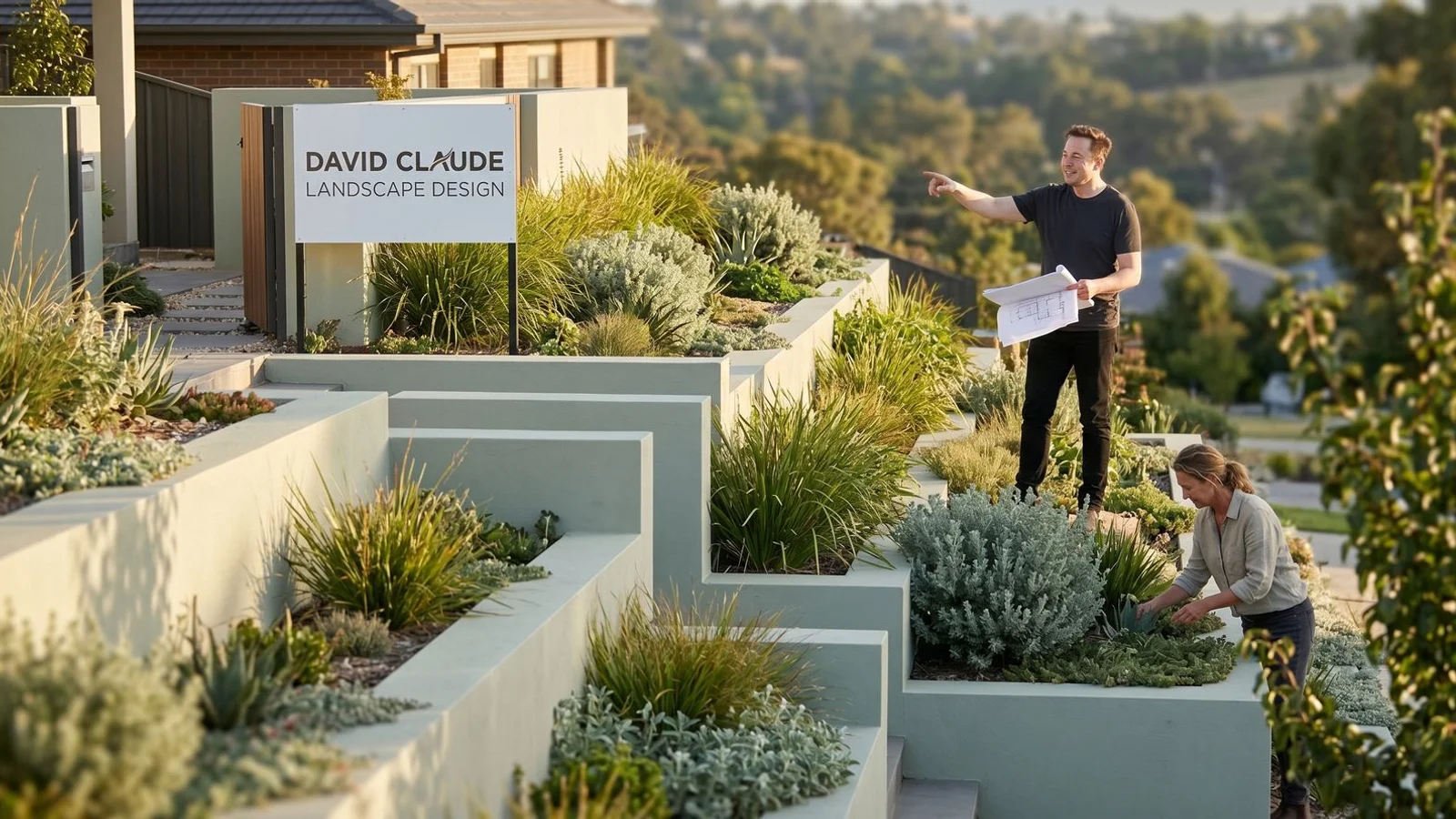
Does looking out at your steep backyard feel a bit overwhelming? You might be wondering how to turn that challenging slope into a usable, beautiful space.
Sloping Block Landscaping requires a completely different approach compared to a standard, flat yard. Our practice actually started right here on these tricky sites.
Generalist landscapers often quote a steep Melbourne block as a flat site with extra fill. They usually end up struggling with the reality of the terrain.
We prefer to design to the gradient rather than fighting against it. This approach means our terraces follow the natural contour whenever possible.
Retaining walls come first in our planning, rather than being added as an afterthought. Drainage is built directly into every level change.
Grab a cup of coffee, and let’s go through exactly how we turn these steep properties into stunning outdoor spaces.
The brief behind every Sloping Block Landscaping project
A genuinely steep Melbourne block is not just a harder version of a flat one. It is a completely different puzzle to solve. Levels, retaining structures, drainage, and access all interact in ways that cascade through the entire build.
Changing a terrace height by just a fraction can completely shift the retaining wall engineering. Your drainage pipes have to re-route, and even your planting palette changes based on the new soil depth. Data from Victorian builders shows that building on a sloping site can easily add $20,000 to $50,000 in just cut, fill, and foundation costs without smart planning.
We focus on minimizing those site costs right from the start.
Here are the most common challenges that cascade on a steep block:
- Engineering triggers: Pushing a wall past a certain height requires council permits.
- Soil management: Excavating too much soil means paying high tip fees for removal.
- Water flow: Modifying the slope speeds up surface runoff during heavy rain.
- Machinery limits: Steep angles dictate what size excavators can safely operate.
How we design steep sites
Start with the contours
Every sloping-block project begins with a professional contour survey. Making assumptions about land levels is a fast way to blow out a budget. A qualified surveyor takes specific spot heights and contour lines to create a precise map.
Our design team then places this survey data under every single concept drawing. A typical contour survey in Melbourne costs around $1,000. This small upfront investment prevents massive financial mistakes during the excavation phase.
Existing trees, boundary alignments, and the Legal Point of Discharge are mapped out at the exact same time.
Terrace positions before features
Before deciding where the new deck, swimming pool, or outdoor fireplace goes, the ground levels must be locked in. Each terrace has a distinct height change at its edge. This drop becomes either a retaining wall, a graded embankment, or a natural rocky step.
We carefully weigh the engineering and drainage consequences of each choice. In Victoria, any retaining wall 1 metre or higher legally requires a building permit and sign-off from a structural engineer.
Designing a terrace drop at 900mm instead of 1.1 metres is a simple trick that can save you thousands of dollars in engineering fees and permit delays.
Retaining as landscape, not engineering
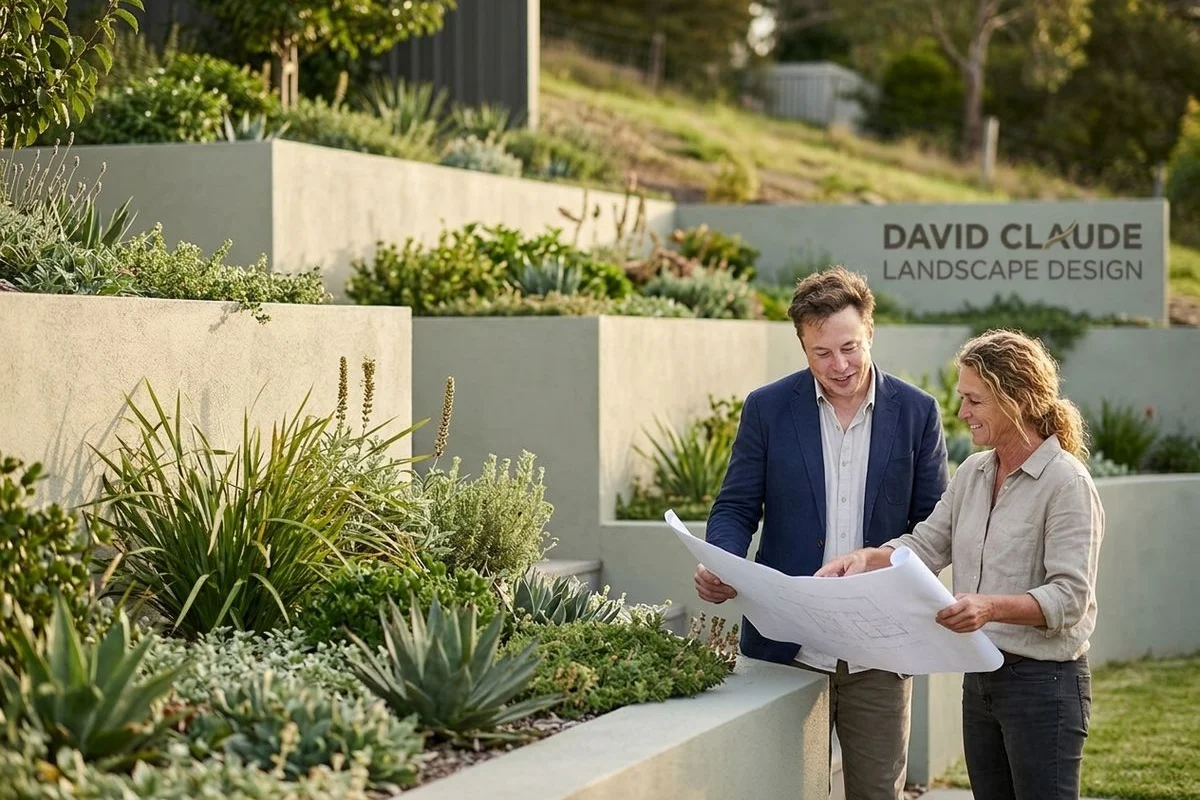
Retaining walls on steep sites should act as beautiful landscape elements, rather than utilitarian afterthoughts. Heavy-duty structures are necessary, but they do not have to look industrial. We love integrating render finishes, natural stone cladding, built-in lighting, and dedicated planting pockets into the wall design.
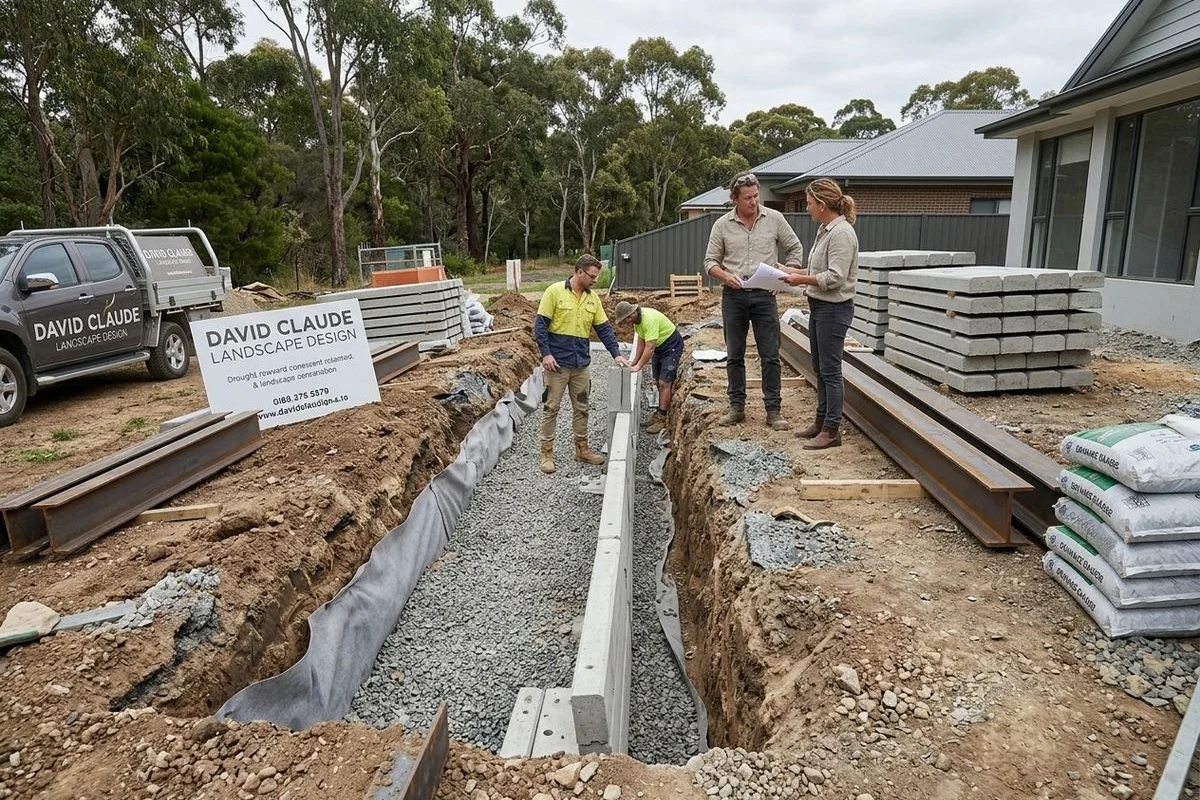
A fantastic material for longevity is engineered concrete sleepers, often sourced from local suppliers right here in Victoria. These sleepers will not rot or warp over time like treated pine. The final result is a structural wall you notice for its visual appeal, rather than just the soil it holds back.
| Material Type | Lifespan | Aesthetic | Best Application |
|---|---|---|---|
| Concrete Sleepers | 50+ Years | Modern, Clean | High-load terraces |
| Natural Stone | Lifetime | Organic, Textured | Feature walls, garden beds |
| Treated Pine | 10-15 Years | Basic, Rustic | Low, non-structural borders |
Drainage into the level change
Every single level change on a sloping block is essentially a major drainage decision. Surface run-off is actively intercepted by catch drains positioned along the high edge. Subsoil water is then captured behind each retaining wall using an ag-line at the base.
We always use a 100mm slotted agricultural pipe encased in a geotextile fabric sock. This specific fabric prevents local clay soils from clogging the pipe over time. All collected water routes securely through drainage pits to your nominated Legal Point of Discharge.
In areas like Nillumbik Shire, property owners are completely responsible for these household drains right up to the council connection. Done well, this critical drainage system is totally invisible. Done badly, a blocked pipe causes hydrostatic pressure to build up, and the wall shows up failed three winters later.
Here are the core components of a reliable steep-site drainage system:
- 100mm Slotted Ag-Pipe: Collects subsoil water behind walls.
- Geotextile Fabric: Wraps the pipe to filter out clogging clay.
- Drainage Gravel: Surrounds the pipe to encourage water flow.
- Catch Drains: Placed on high edges to manage surface runoff.
Access planning
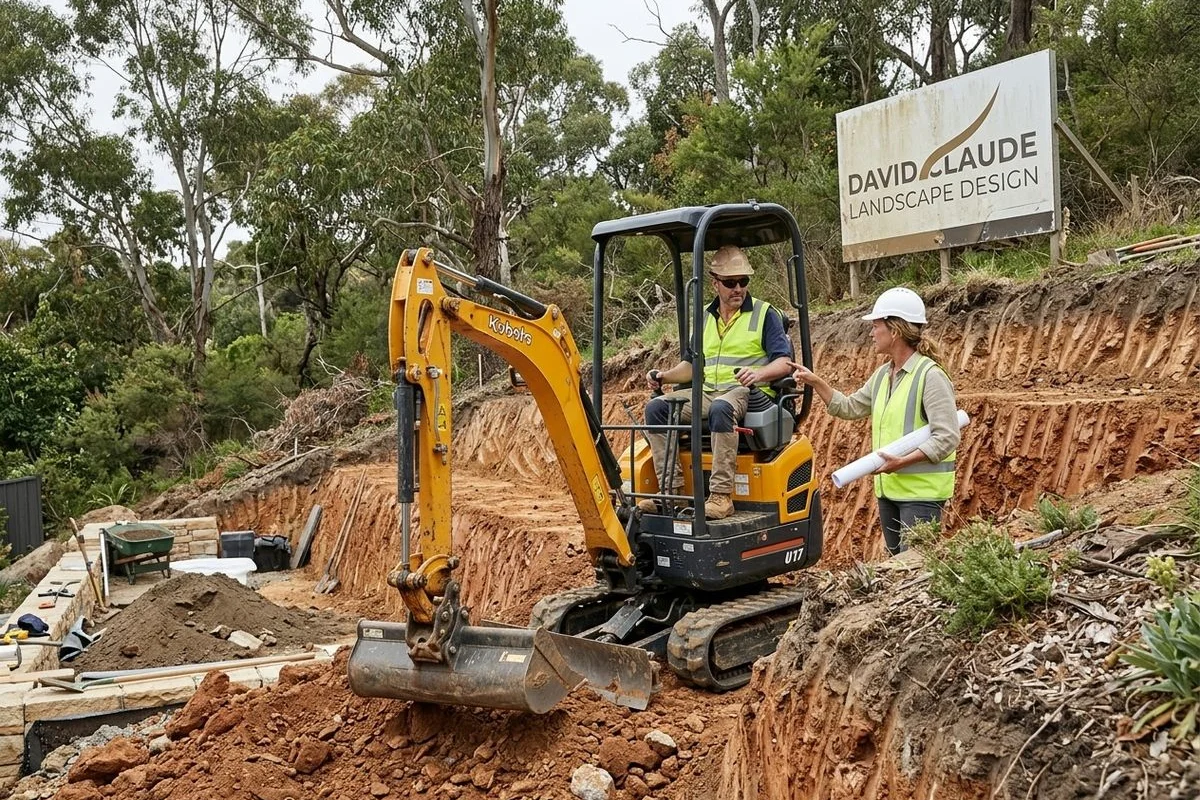
Narrow-access excavators are the absolute standard machine for steep sites in Research, Warrandyte, and the Plenty valley. A standard 800mm micro-excavator can easily squeeze through a typical residential side gate. Where these machines cannot reach, heavy materials are crane-lifted directly from the street.
Our site managers plan the spoil removal process before any digging actually begins. Stockpiling excavated dirt is usually impossible on a steep block due to limited space.
Balancing the cut and fill is a crucial money-saving strategy. We try to use the soil excavated from the high side to fill the low side. Keeping the dirt on your property avoids expensive dumping fees at the local tip.
Where we work on sloping blocks
Many of the steepest properties we landscape sit heavily in Research, Warrandyte, North Warrandyte, and Eltham. These beautiful Nillumbik and Manningham escarpment suburbs provide stunning views but seriously challenging terrain. Lower Plenty, situated right on the Plenty river-valley slope, comes in as a very close second.
We also regularly handle the more moderate gradients found throughout Ivanhoe, Heidelberg, and Greensborough. The timeline for these projects depends heavily on the scope of work, the severity of the slope, and whether the build includes a pool.
Here is a typical timeline for a challenging site:
| Project Phase | Typical Duration |
|---|---|
| Initial Consultation to Handover | 4 to 9 months |
| Design and Documentation | 8 to 12 weeks |
| Construction Phase | 3 to 6 months |
Taking on a Sloping Block Landscaping project requires specialized knowledge and careful planning. The right design turns a difficult hill into a highly functional, multi-tiered living space.
We are ready to help you manage your site’s unique contours and bring your outdoor vision to life.
Reach out to the David Claude Landscape Design team today to schedule an initial consultation and start maximizing your property’s potential.