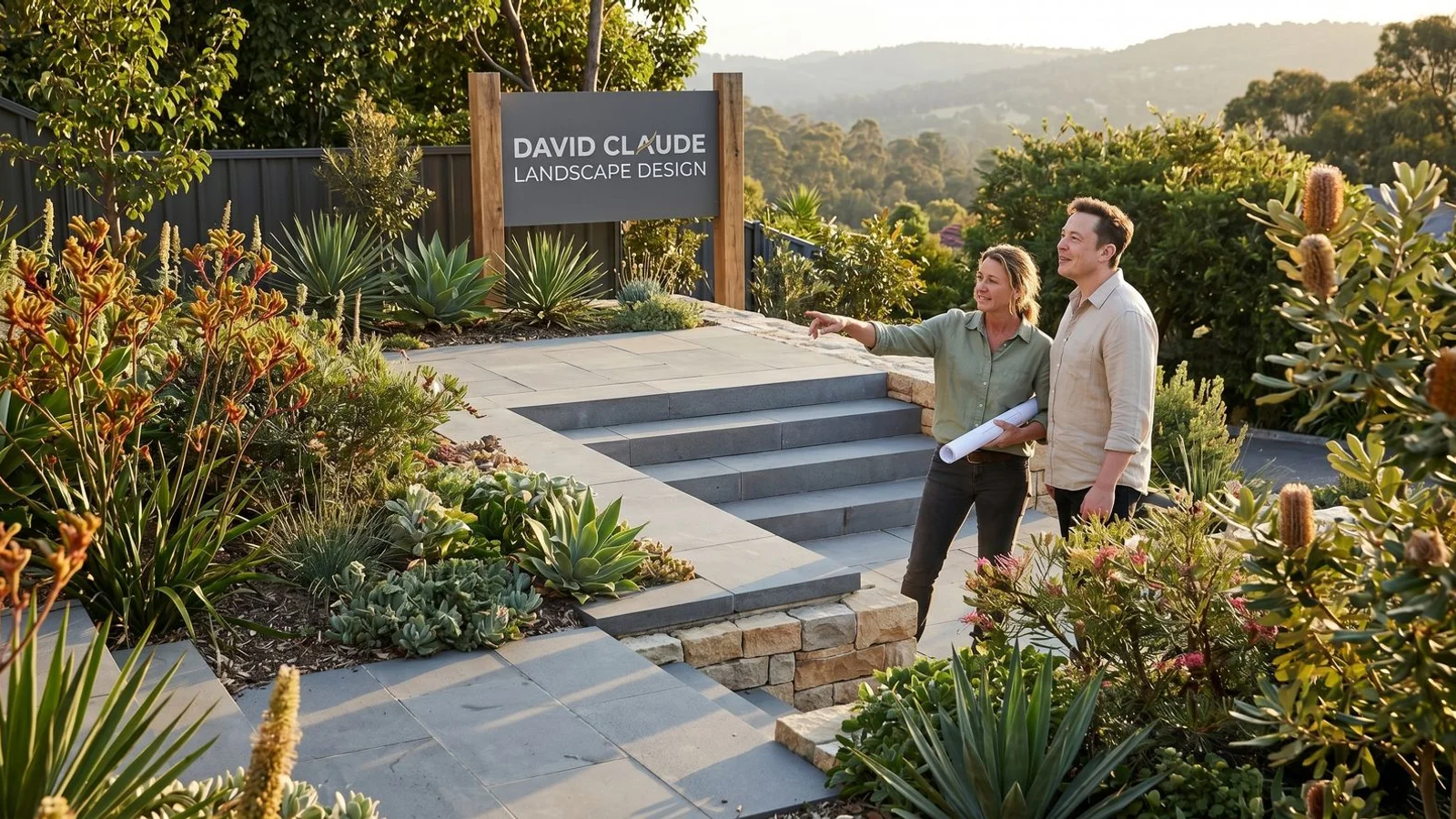
You know how frustrating a steep backyard can be to manage in Melbourne’s hilly eastern suburbs. Designing a steep garden frequently scares buyers away, but a strong gradient is actually a massive landscaping asset if handled correctly.
At David Claude Landscape Design, we provide premier landscape architecture and construction services to turn these exact challenges into stunning spaces. The key takeaway from recent local projects is that you need accurate data before moving any soil.
Here is a practical breakdown of terracing design Melbourne regulations, drainage solutions, and plant selection for a difficult site.
Start with the contours
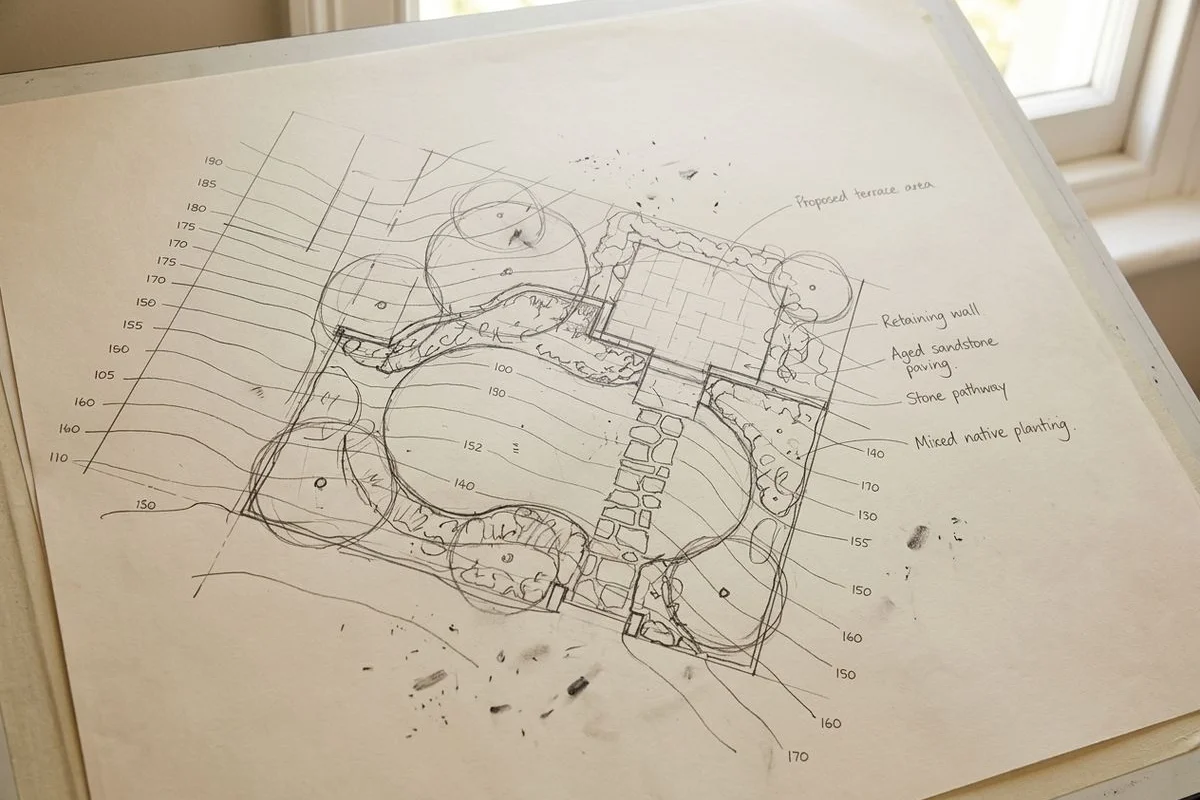
Slope-aware design must begin with an accurate contour survey rather than a rough pencil sketch. We always tell clients that skipping this step is a fast way to guarantee expensive excavation mistakes later. A qualified surveyor will map spot heights and contour lines at exact 0.5m or 0.25m intervals across your entire site.
Current 2026 industry data shows that a professional contour survey for a complex sloping block in Melbourne costs between $1,500 and $2,500. This upfront investment prevents thousands of dollars in wasted materials.
Our designers rely on this survey to capture several critical site features:
- Precise boundary alignments to ensure legal compliance.
- Existing mature trees and their root zones.
- The exact legal point of discharge for stormwater.
- Neighbouring ridge and gully lines that affect water runoff.
Without these hard numbers, every downstream decision about ground levels is simply a guess. Accurate data turns terrace heights, retaining positions, drainage paths, and circulation into deliberate design choices rather than nasty site discoveries.
Terracing principles
Flat living zones on a gradient require stepped terracing to cut into the slope and fill away from it. This process creates level plateaus that are firmly held back by retaining walls. The vertical spacing between these newly formed terraces is the very first design decision you have to make.
We default to building walls between 800mm and 1.2m per terrace on moderate slopes. Victoria building regulations dictate that any retaining wall reaching 1 metre or higher strictly requires a local council building permit and structural engineering sign-off. Keeping a wall at 800mm is a strategic move to avoid costly engineering fees and weeks of permit delays.
| Terrace Wall Height | Council Permit Status | Structural Engineer Needed? |
|---|---|---|
| Under 1 Metre (e.g., 800mm) | Exempt (in most areas) | No |
| 1 Metre or Higher | Mandatory Permit | Yes |
Steeper sites will naturally force retaining walls up to 1.8m or 2m in height. Our landscape designers carefully assign a specific purpose to each of these taller plateaus. Every individual terrace needs a defined role, such as a dining space, a flat lawn, a deep planting bed, or a pool zone.
Circulation on gradient
Stairs, ramps, and paths act as the vital arteries connecting your different garden terraces. The National Construction Code (NCC) strictly governs outdoor residential steps in Australia. A compliant staircase must have a maximum riser height of 190mm and a minimum tread depth of 240mm to ensure proper foot safety.
Our construction crews typically build outdoor garden stairs with a highly comfortable 150mm riser and a generous 350mm tread. A well-designed staircase actively prevents leg fatigue on steep residential blocks. The NCC mandates that a single flight of stairs cannot exceed 18 risers without incorporating a flat landing area of at least 750mm squared.
Pro-Tip: Never pour a solid concrete path straight down a steep incline. The hard surface will act as a fast water chute during heavy rain, rapidly eroding the soil at the base of your garden. Always angle your walkways.
We always run path alignments diagonally across the slope rather than straight down the hill. This gentle approach follows the natural site contours and makes walking significantly easier. Ramps require a maximum gradient of 1:14 in areas where wheelchair or equipment accessibility is a primary concern.
Plant selection for slopes
Plants positioned on a gradient have two critical jobs to perform. A good slope plant must look visually appealing while aggressively stabilizing the soil against severe weather erosion. A deep root habit matters significantly more than a pretty flower when planting on an angle.
We highly recommend using resilient native species to lock in the topsoil on Melbourne properties. The most effective options fall into four distinct categories:
- Fast-Spreading Groundcovers: Myoporum parvifolium (Creeping Boobialla) and prostrate Grevillea are top performers for sunny slopes because they spread quickly in heavy clay.
- Shade-Tolerant Creepers: Native violets and Dichondra repens (Kidney Weed) thrive under established trees and provide a dense, soil-stabilizing carpet where sun-loving plants fail.
- Deep-Rooted Shrubs: Hardy varieties like Westringia, Correa, and Callistemon act as permanent structural anchors for the upper soil layers.
- Soil-Binding Grasses: Ornamental grasses like Dianella and Lomandra feature fibrous root systems that effectively tie the vulnerable surface dirt together.
Our preference for using native species on steep blocks is entirely functional rather than ideological. Victorian natives are simply the best equipped plants to handle our dry summers and poor soils while keeping the hillside firmly intact.
How this connects to our sloping block service
Every single slope project must follow a very strict sequence of operations to guarantee long-term stability. A rushed job easily leads to structural failures and dangerous soil movement. The proper order includes an initial survey, detailed terrace planning, calculating retaining options for steep sites, drainage integration, and final planting.
We treat the design phase as the most important part of the entire programme. Getting these plans approved sets the whole schedule in stone before a single excavator arrives on your property. This calculated approach saves money and prevents nasty surprises.
Conclusion: Designing a Steep Garden
Designing a steep garden requires precise contour data, strategic terracing decisions, and smart plant selection. A difficult slope does not have to remain an unusable eyesore in your backyard.
We strongly encourage you to secure a professional contour survey as your very first step. A clear topographical map of your land will instantly reveal the true structural potential hidden within the gradient.
Reach out to our landscape design team today to discuss your site and start planning a safe, beautiful outdoor space.