You know how quickly a heavy downpour can turn a beautiful garden into a miniature river system. When planning drainage, sloping block sites deal directly with intense volume, dangerous velocity, and the critical need for interception.
Our team sees this constantly across Melbourne’s eastern suburbs, where heavy seasonal rains meet challenging terrain.
That sheer volume of water moves fast across a gradient, gathers destructive energy, and can easily erode soil or flood downstream zones unless it is managed correctly. We cannot rely on basic flat-site solutions when gravity is working against us.
Let’s look at the data, see what the building codes actually require, and outline the exact network your property needs to stay dry.
Drainage changes on slopes
Tackling steep terrain requires managing high water velocity and sheer volume through active interception. Flat-site drainage simply deals with short distances and gentle falls, which is completely inadequate for a hillside.
Our landscape architects approach steep block drainage Melbourne projects by focusing on energy dissipation. According to 2022 Bureau of Meteorology data, Melbourne’s eastern suburbs like Ferny Creek can receive over 1,600mm of rainfall annually, making this a critical structural issue. A standard flat-site pipe will quickly blow out under that immense pressure.
Key differences for slope drainage include:
- Velocity control: Slowing water down before it damages pipes.
- Volume management: Handling sudden, massive downpours.
- Active interception: Catching water before it reaches the house.
We must intercept, slow down, and carefully direct this runoff. If left unchecked, it will inevitably undermine retaining walls and flood your downstream living zones.
The network on a typical sloping site
A proper hillside drainage design acts as a series of defensive lines against water movement. The system requires multiple integrated components to catch and redirect runoff effectively.
Uphill catch drain
An uphill catch drain intercepts overland flow right at the high boundary before it ever reaches your house or garden. This surface channel or slot drain is the single most important drainage element on a steeply-graded site.
Without this first line of defense, every major storm dumps thousands of liters of water directly onto your property. We always install these interceptor drains to cut off the water supply at the source. This completely prevents unnecessary moisture from saturating your middle and lower terraces.
Behind-wall ag-line
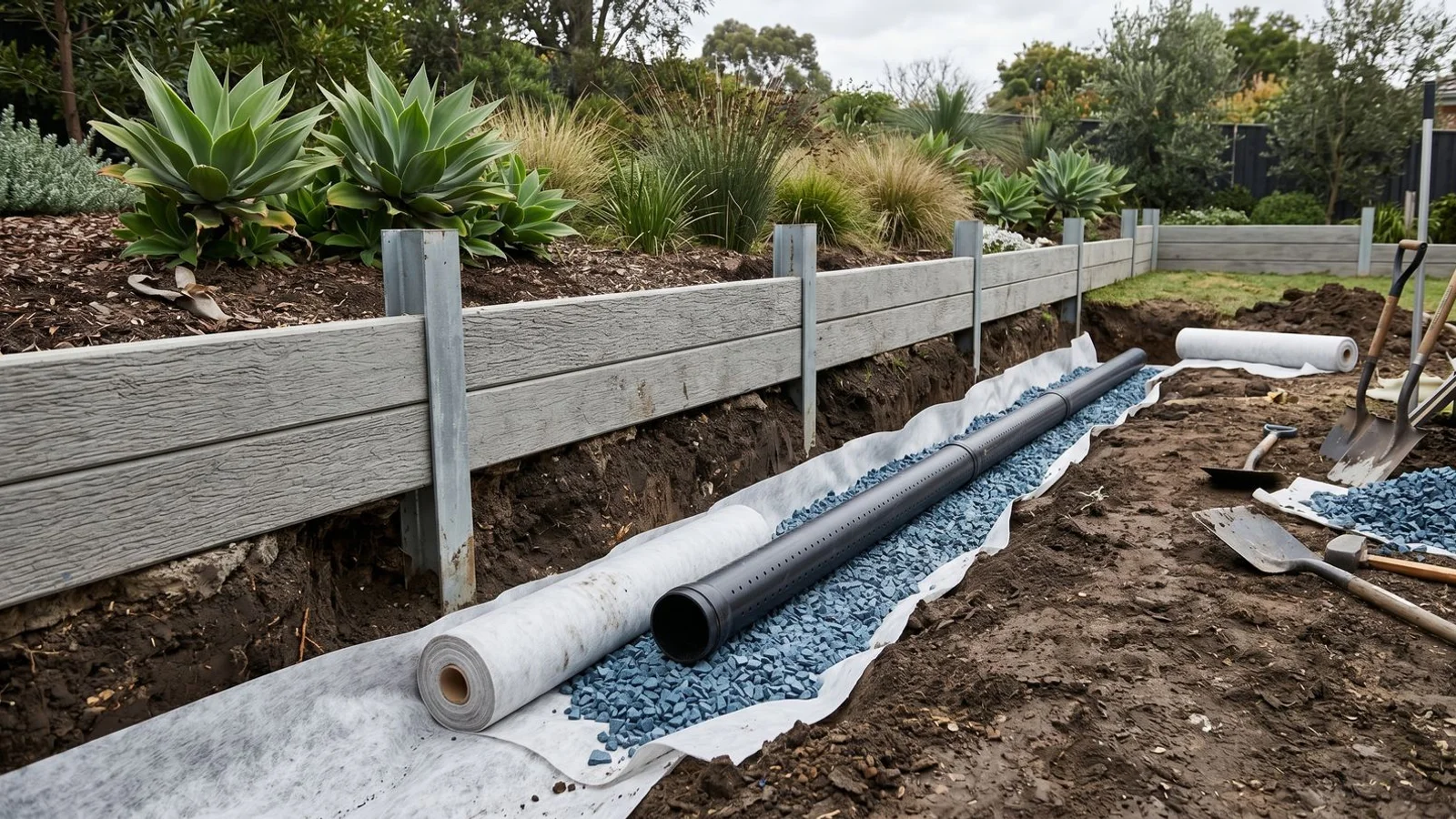
Every retaining wall on a sloping site must have a heavy-duty ag-line running along its base. This slotted 100mm pipe sits in a gravel-filled trench to capture sub-surface water.
Our standard practice in Melbourne’s reactive clay soil is to use an AS/NZS 1254 compliant slotted PVC pipe wrapped in a protective geofabric sock. Un-socked pipes clog with fine clay silt in a matter of months. If that pipe blocks, hydrostatic pressure builds up fast and causes drainage-related wall failure.
We surround the entire pipe with 10mm to 20mm drainage gravel to ensure maximum water flow. This specific setup guarantees the wall remains stable during heavy spring rains.
Field drains under planting and lawn
Ag-line field drains placed at 3 to 5-meter spacings prevent severe waterlogging where planting beds or lawns sit on dense clay subsoil. This sub-surface network gives excess water a fast escape route out of your garden.
Our local clay soils are notorious for trapping moisture near the surface. Without these field drains, the top 300mm of soil stays completely saturated through the winter months. Your expensive plants and lawn will quickly suffer from root rot in those waterlogged conditions.
We strategically map out these drainage grids to keep the soil aerated and healthy. It makes a massive difference in the long-term survival of your landscape.
Pit network and legal point of discharge
All of these sub-surface ag-lines must terminate at pits, which then connect through sealed pipes to your property’s legal point of discharge. These pits are usually 300x300mm grated inspection boxes that allow for easy cleaning.
The local council strictly dictates this legal point of discharge based on your property boundaries. On most Melbourne sites, this final destination is the street kerb. For steeper blocks that slope away from the road, the council might mandate an approved soakage pit or a connection to a shared drainage easement.
Our team ensures the entire system handles the volume without overflowing these terminal points. Sometimes, this requires installing an on-site stormwater detention unit to slow the release of water into the public system.
Falls and minimums
Pipe falls must be carefully calculated to maintain a safe water velocity across a steep drop. Standard subsoil pipes require a minimum fall of 1:100, while surface falls on paving need a 1:80 gradient.
Catch drains are set at a steeper 1:50 fall to ensure surface water moves quickly away from structures. When the site gradient is much steeper than these minimums, water velocity becomes a serious hazard.
We step the sealed pipe down the hill using precast concrete drop-boxes rather than running it at full slope speed. High-velocity water moving rapidly down a steep grade will literally erode pipe joints and blow out fittings over time.
| Drainage Element | Minimum Fall Gradient | Purpose |
|---|---|---|
| Subsoil Ag-Pipe | 1:100 | Gentle sub-surface flow |
| Paved Surfaces | 1:80 | Surface shedding |
| Catch Drains | 1:50 | Rapid overland diversion |
| Steep Site Pipes | Drop-boxes needed | Velocity and energy reduction |
This stepped approach dissipates the water’s kinetic energy before it reaches the bottom of your block. It is a mandatory engineering step for hillside stability.
Integration with retaining, hardscape and planting
Drainage is a core design layer woven through every other landscaping decision on a sloping site, never just an afterthought. It dictates exactly where retaining walls, patios, and heavy planting zones can safely go.
Our comprehensive drainage service is most often delivered as part of a whole-site design rather than a simple retrofit. Trying to dig trenches and lay pipes after a garden is finished is an expensive nightmare.
We integrate these hydraulic plans right from the initial concept phase to meet stringent local building codes. Key benefits of early integration include:
- Cost savings: Avoiding expensive rework or tearing up finished patios.
- Aesthetic alignment: Hiding pits and pipes seamlessly within garden beds.
- Structural security: Ensuring walls are built to handle maximum hydrostatic pressure.
This proactive strategy ensures your new landscape is beautiful, structurally sound, and fully protected from storm damage.
Start by evaluating your property’s natural falls during the next heavy rain to see where water naturally pools. When you are ready to upgrade your drainage, sloping block expertise is just a phone call away to secure your site for the long term.