You know how quickly a sudden Melbourne downpour can turn a stable bed into a muddy runoff channel.
We see this scenario play out every winter across the north-eastern and inner-eastern suburbs, highlighting the urgent need for a proper erosion control sloping garden strategy.
To combat this, the team at David Claude Landscape Design has spent years refining a system that locks earth in place before the damage occurs.
Let’s look at the specific data behind this soil erosion Melbourne issue, what it is actually telling us, and explore a few practical ways to respond.
How erosion starts and accelerates
Erosion on a Melbourne hillside usually starts as simple rainfall striking bare soil. The first storm creates small channels, and subsequent storms deepen them into rills and then gullies.
Once these gullies form, water velocity increases, and the rate of soil loss accelerates quickly.
We often observe that an unprotected slope can lose over a tonne of soil per hectare during a single severe weather event. Unchecked water flow strips away the vital top layer, leaving behind an infertile base.
”In vulnerable areas of Victoria, average hillslope erosion rates sit around 1.3 tonnes per hectare per year, but sudden storms push these numbers much higher on bare inclines.”
Clay subsoils in Nillumbik and eastern Manningham are particularly prone to this destruction because the topsoil layer is often very thin. Losing that surface exposes reactive Sodosols and Chromosols that perform poorly for planting. This creates a destructive feedback loop, where worse planting means more bare soil, and more bare soil guarantees faster degradation.
What is the three-layer approach we use for an erosion control sloping garden?
A comprehensive strategy requires a multi-layered defense to be truly effective. Our methodology builds stability from the ground up, starting with biology and finishing with structural engineering. This sequence ensures immediate protection while establishing long-term resilience.
Ground cover: the biological layer
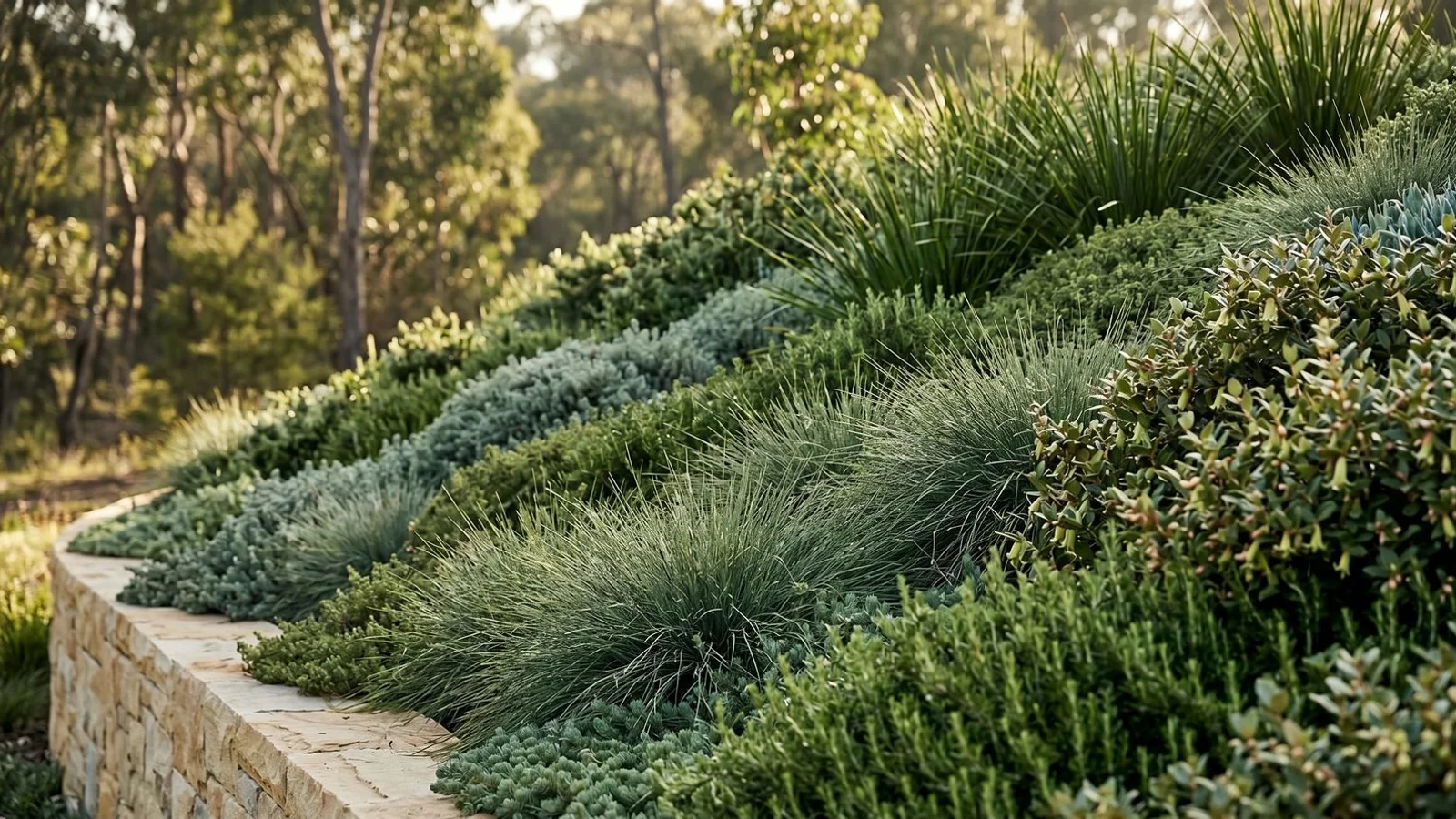
Dense, low-growing plants with extensive root networks are the ultimate long-term stabilisation solution. Spacing is critical for success, and planting three to four tube-stock plants per square metre achieves rapid canopy closure.
Our preferred biological stabilisers include:
- Myoporum parvifolium: Spreads quickly across 1 to 2 metres per plant.
- Prostrate Grevilleas: Knits roots deeply into the top 300 millimetres of soil.
- Native Violets & Creeping Boobialla: Perfect for shaded or moderately graded areas.
- Tall Sedge (Carex appressa): Forms dense tussocks that secure stream banks and waterlogged zones.
Once established, these native varieties are entirely self-maintaining within 12 to 18 months. They reduce topsoil loss almost to zero on moderate gradients.
Erosion matting: the transitional layer
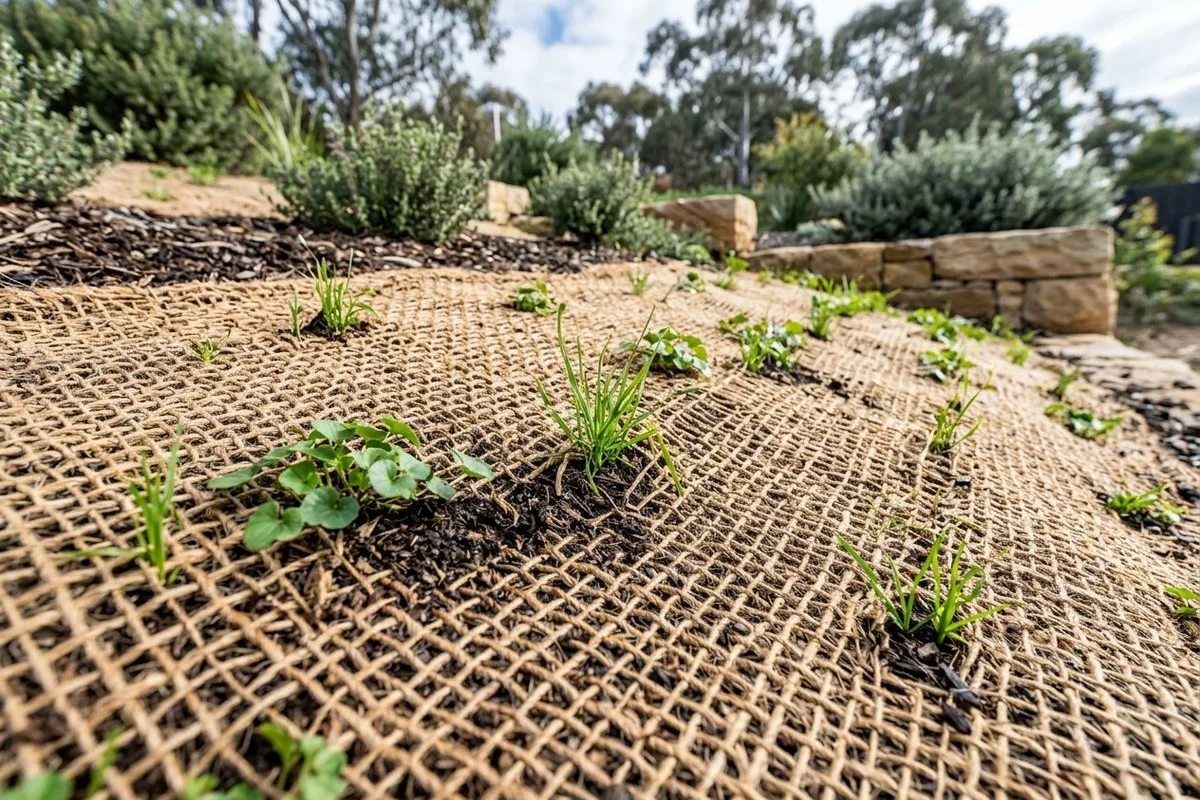
In the critical months before new planting establishes, jute or coir erosion matting is pegged securely over the slope. The matting physically holds the earth in place during storms, reduces raindrop impact, and completely biodegrades over two to three years as the vegetation takes over.
Without this protective layer, a freshly planted incline can easily lose 50 millimetres of topsoil in a single heavy winter.
We utilise different weights of matting depending on the gradient severity.
| Matting Type | Ideal Application | Weight | Typical Cost (per roll) | Lifespan |
|---|---|---|---|---|
| Woven Jute Matting | Standard garden slopes | 750gsm | approx. $46 | 12 - 18 months |
| Coir Mesh Matting | Steep or exposed terrain | 1000gsm | approx. $214 | 24 - 36 months |
Silt fencing and terraces: the engineering layer
During earthworks and active construction, silt fencing along the low edge of disturbed zones captures run-off sediment before it reaches local stormwater systems. On steeper gradients, short mid-slope terraces or check-dams slow the water velocity down enough to prevent deep gullying.
Our installation process strictly adheres to the Environment Protection Authority (EPA) Victoria guidelines. A common mistake amateur builders make is failing to trench the fabric properly.
- Stapling fabric to the front of posts instead of the trench side.
- Leaving gaps where two sections of fencing meet.
- Allowing sediment to build up higher than one-third of the fence height.
- Using lightweight agricultural shade cloth instead of rated geofabric.
The EPA standards require a 150-millimetre deep trench for the geotextile to effectively filter runoff and prevent a catastrophic blowout from beneath.
Failing to secure this barrier can lead to heavy financial penalties. We always remind clients that minor environmental breaches, like allowing sediment into a council drain, can trigger an EPA infringement notice of over $5,900. Taking the time to install these engineering controls correctly saves both the local waterways and your budget.
What warning signs should owners act on for hillside erosion control?
Spotting the early symptoms of a failing slope allows for rapid, cost-effective intervention. The landscape will always give you subtle clues before a major collapse occurs.
Our experts recommend walking your property after every major rainfall event to look for specific indicators. You should immediately note any areas where water is pooling unusually or carving new paths.
Key indicators of active topsoil displacement include:
- Small rills or miniature channels appearing on bare earth after rain.
- Silt deposits accumulating at the bottom of the slope or against fences.
- Exposed root systems on mature trees, indicating the ground has washed away.
- Preferential flow lines radiating away from the base of large trees.
- Ponding or diversion of water away from your intended drainage grates.
If you observe any of these symptoms, wait exactly one storm to confirm the pattern, and then intervene. Early stabilisation costs around $3 to $5 per square metre for basic matting and planting. By the time a gully has formed, the mechanical reshaping and structural retaining costs multiples of that early intervention price.
How does erosion control integrate with drainage and retaining?
Effective prevention does not work as a standalone fix. It only succeeds when designed alongside drainage on the slope and integrated with solid retaining structures.
We frequently install sub-surface French drains packed with durable river rock to manage underground seepage. Redirecting this hidden moisture prevents the heavy clay from becoming waterlogged and sliding downhill.
To create a fully integrated system, consider these three crucial connections:
- Surface flow must be directed into designated spoon drains.
- Sub-surface water requires agricultural pipes wrapped in protective geofabric.
- Retaining walls must feature clean aggregate backfill to relieve hydrostatic pressure.
Our sloping-block service treats the planting, the drainage, and the retaining walls as one coupled system. This holistic planning ensures that water is managed safely from the highest point of your boundary down to the street level.
Protecting a tiered Melbourne property requires attention to detail and a proactive mindset. Catching the early signs of runoff saves significant landscaping expenses down the track, and forms the basis of any good erosion control sloping garden plan.
We encourage you to inspect your property after the next heavy rain to identify any vulnerable patches. Reach out to our team today to discuss a long-term stabilisation strategy that keeps your soil exactly where it belongs.