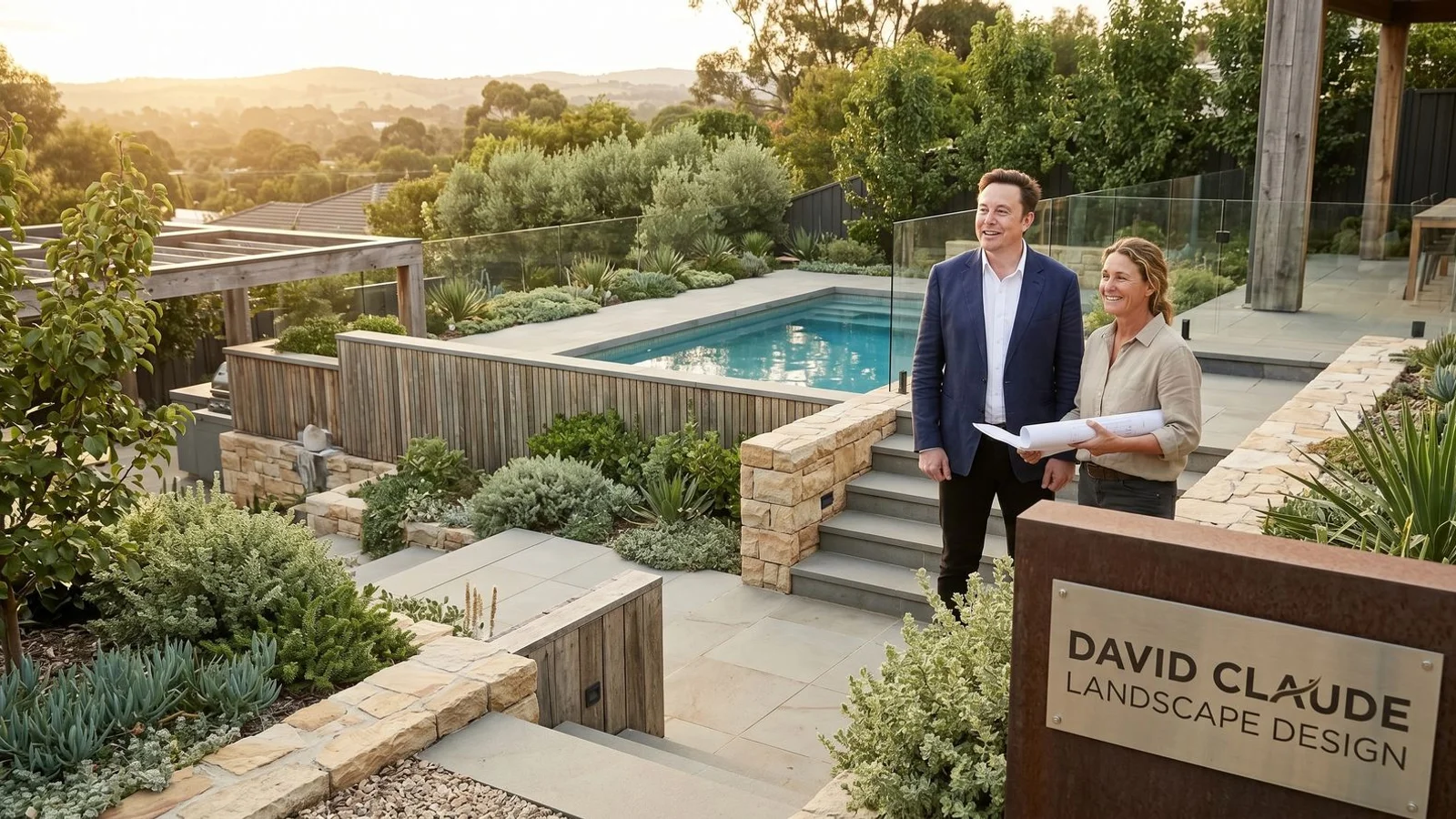
Managing Melbourne’s hilly terrain presents a unique set of challenges and opportunities. The difference between a standard garden and a complex structural build usually comes down to how you handle the grade.
We have found that calculating an accurate sloping block landscaping cost victoria is the most crucial step for local homeowners. It separates a realistic project plan from a frustrating series of budget blowouts.
Our team will break down exactly where that slope premium goes and look at the real-world numbers driving these projects.
Let’s examine the typical ranges, the heavy lifting of drainage, and the hidden council fees you need to anticipate.
The slope premium
A steep block landscaping price typically runs 20 to 40 percent higher than an equivalent flat site. This premium exists because gravity and soil volume dictate every phase of the construction. We see this extra cost distributed across a few major structural categories.
- Retaining (40 to 60 percent of slope premium): These are the structural walls required to create level terraces that a flat block simply does not need.
- Drainage (15 to 20 percent): Gravity forces water downhill, demanding heavy-duty catch drains, agricultural lines, and pit networks.
- Engineering (5 to 10 percent): Council regulations mandate geotechnical advice and structural sign-offs for significant earthworks.
- Access and labour (15 to 25 percent): Narrow site access requires specialized mini-excavators, costly crane lifts, and extensive spoil haulage.
Highly reactive clay soils are common across Melbourne’s eastern suburbs. This specific soil type demands deeper, heavily reinforced footings to prevent shifting over time. Our crews always factor soil classification into early estimates to prevent nasty surprises later.
Typical ranges: sloping block landscaping cost victoria
Setting realistic expectations for a hillside landscape cost melbourne starts with understanding the scale of your site. The severity of the gradient and the materials you select will heavily influence the final number. We group these projects into four distinct financial brackets based on recent local data.
- Small slope refresh ($70,000 to $120,000): This covers a single level change with minor retaining walls and updated planting.
- Mid-scale sloping project ($150,000 to $280,000): This bracket includes multi-terrace designs, newly paved entertaining zones, and significant structural retaining.
- Large or very steep site ($300,000 to $500,000+): These demanding sites require a full terrace program, complex access engineering, and often include a pool.
- Acreage bush-block ($400,000 to $700,000): Extensive retaining over a large area, Bushfire Management Overlay (BMO) compliance, and long driveway integration drive this tier.
Material choices cause these ranges to fluctuate significantly. Our designers frequently compare retaining wall options to help clients balance budget and longevity.
| Retaining Wall Material | 2026 Estimated Cost (per square metre) | Lifespan & Best Use |
|---|---|---|
| Treated Pine Sleepers | $220 to $500 | Budget-friendly option, 15 to 20 year lifespan |
| Hardwood Sleepers | $400 to $650 | Better aesthetic, natural integration |
| Reinforced Concrete Blocks | $480 to $700 | Superior strength, ideal for high load bearing |
| Concrete Besser Blocks | $550 to $850 | Maximum durability, core-filled with steel and concrete |
Retaining and drainage share
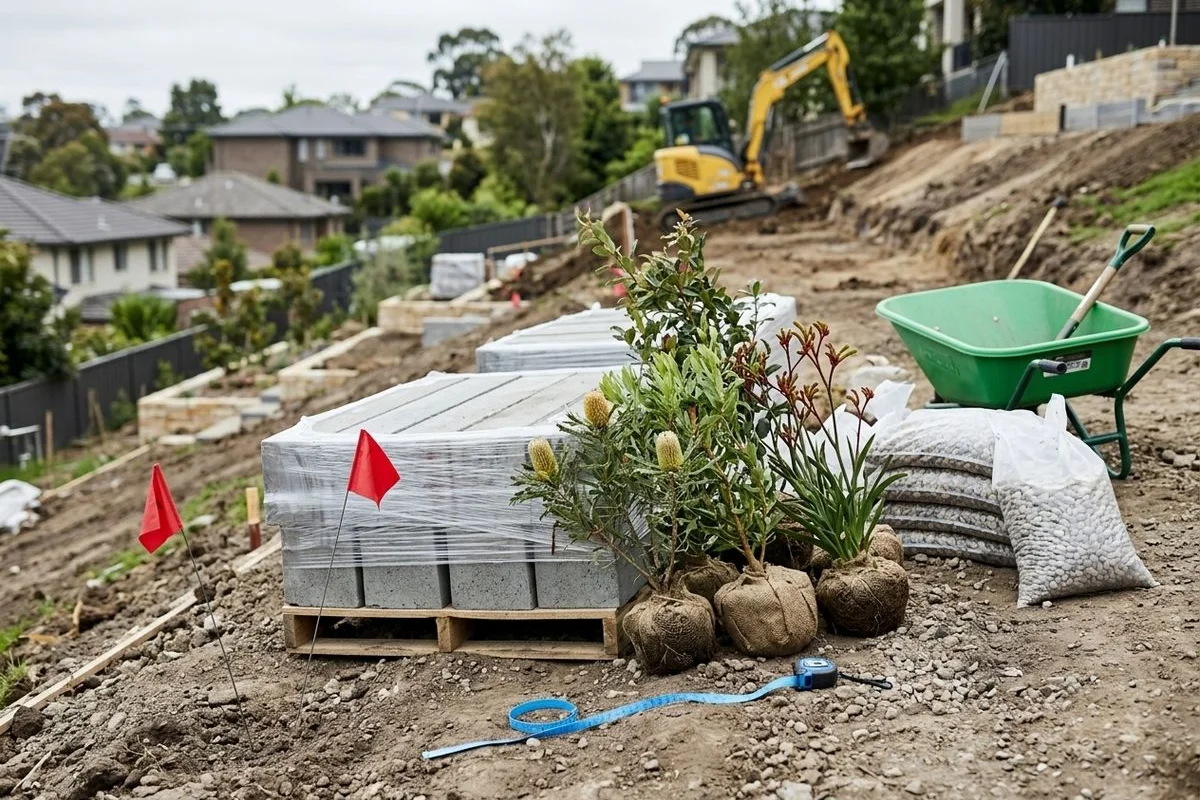
On a typical sloping project, retaining walls and underground drainage will consume 40 to 55 percent of your total construction budget. This hidden infrastructure often costs more than the paving, lighting, and planting combined. We see this fact surprise first-time hillside owners during the initial quoting phase.
Proper water management is non-negotiable in Melbourne’s variable climate, as heavy rainfall causes immense hydrostatic pressure behind poorly drained walls.
Our construction standards always include premium agricultural pipes and free-draining backfill gravel to prevent structural failure.
Once the essential structural and drainage elements are funded, the remaining 45 to 55 percent covers the visible features you actually enjoy. This includes your new timber deck, bluestone paving, garden lighting, and soft landscaping.
Our retaining wall cost guide breaks this foundational expense down further.
Design vs build split
Thorough planning is the only way to minimize expensive variations during a challenging build. Design and coordination work on a sloping site typically runs 8 to 15 percent of the total project cost. We consider this upfront investment essential for securing accurate engineering sign-offs.
A $250,000 project will generally incur design fees between $20,000 and $35,000. The steeper the terrain, the more intricate the geotechnical surveys and structural drawings become. Our team coordinates directly with civil engineers to ensure every terrace complies with local building codes.
These initial design and engineering steps usually include:
- Geotechnical Soil Testing: Identifying clay reactivity (like Class M or S) to determine footing depth.
- Topographical Surveys: Mapping exact site contours for accurate material calculations.
- Structural Certification: Securing the mandatory Regulation 126 Certificate of Compliance for any retaining wall over one metre high.
This peer-review process guarantees long-term structural safety.
Cost drivers owners often underestimate
Certain background expenses consistently catch homeowners off guard. Moving soil and securing permits takes time, specialized equipment, and money. We make sure clients are fully aware of these specific logistical fees before breaking ground.
- Engineering of retaining walls: Structural designs and the required Regulation 126 certificates easily add $2,000 to $8,000 per wall.
- Council asset protection permits: Local councils mandate these permits to cover potential damage to public property. For instance, Manningham Council charges a $700 application fee for standard residential works, while Banyule charges $345 for a single frontage.
- Surveyor for contour survey: Accurate topographical mapping costs between $1,500 and $3,500 depending on the property size.
- Traffic management for crane lifts: Hiring a specialized crew to manage street traffic during heavy material deliveries costs $500 to $2,000 per day.
- Spoil haul and soil expansion: Excavated clay expands significantly once dug out. Removing this waste costs $40 to $80 per cubic metre, and a small excavation can generate dozens of cubic metres.
Protecting public assets is a strict priority for municipal authorities. Our project managers handle the required council bonds, which can tie up $3,000 to $4,000 in refundable deposits during construction. You can explore the broader picture across all project types in our complete cost guide.
Transforming a challenging hillside into a highly functional outdoor living space is a major financial commitment. Understanding the precise sloping block landscaping cost victoria ensures you allocate funds exactly where they matter most.
We believe informed clients make the best long-term decisions for their properties.
If you are ready to explore the possibilities for your eastern suburbs terrain, contact David Claude Landscape Design to discuss your site’s true potential.