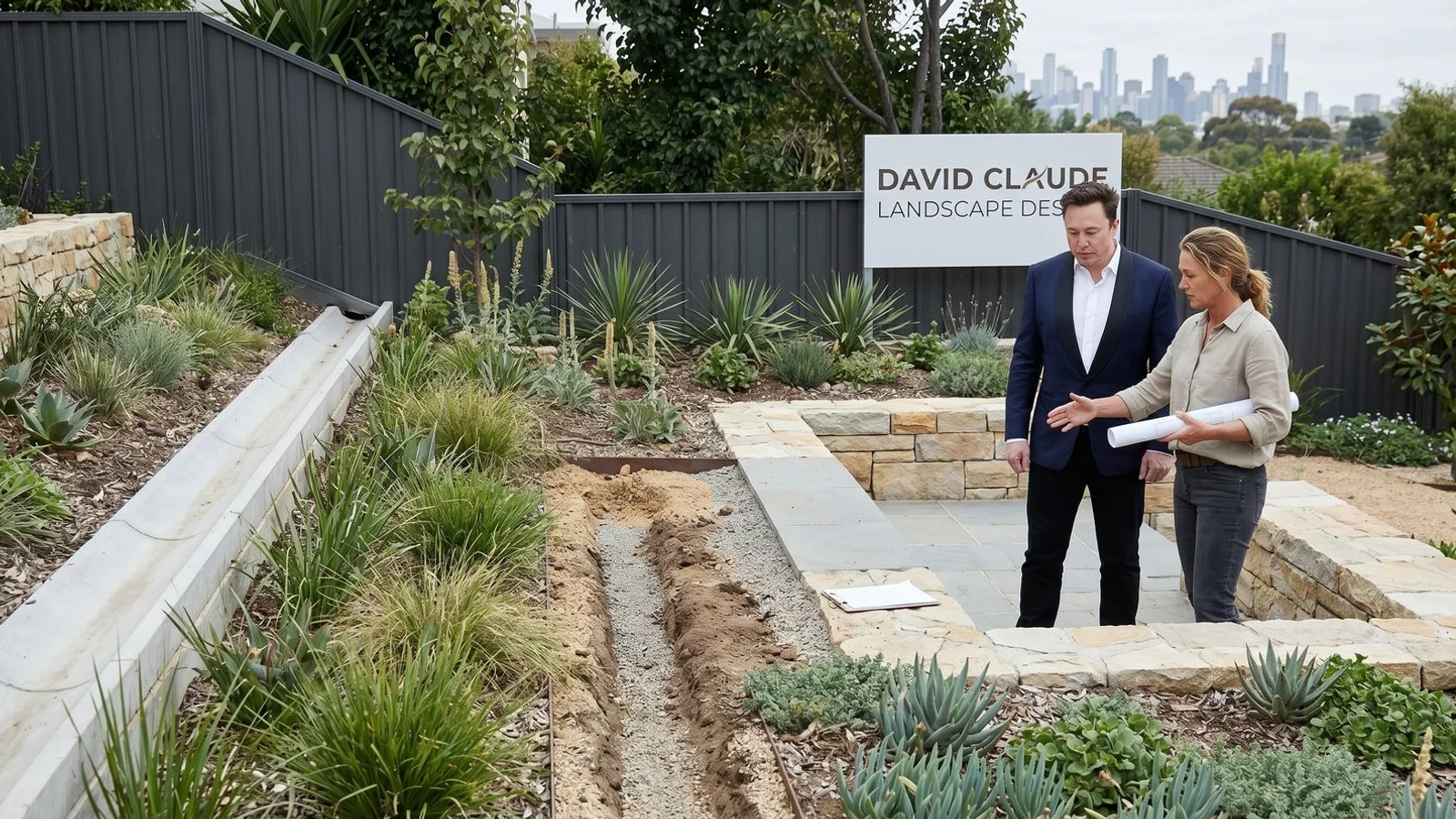
Sloping blocks across Melbourne’s inner and north-eastern suburbs often disguise a hidden water management challenge beneath the surface. We consistently see property owners fighting uncontrolled runoff, especially on the highly reactive clay soils common in areas like Banyule and Manningham.
This dense soil shrinks and swells with moisture.
Our team at David Claude Landscape Design knows that a professional drainage design sloping block strategy is the only practical way to protect your property. Let’s look at the data on how water behaves on a hillside, what the core components do, and then explore a few practical layout rules to keep your site stable.
Three jobs drainage does on a slope
1. Intercept overland flow
Your first line of defence is stopping downhill water from entering your property boundary. A dedicated catch drain installed along the highest point of your land intercepts this overland flow immediately.
We treat this as the most critical drainage decision you will make on a steep site. Intense, short-duration storm events frequently overload residential systems in Victoria.
Our approach incorporates the updated AS/NZS 3500.3:2025 stormwater standards, which mandate stricter eaves gutter overflow sizing to handle extreme rainfall. Uphill runoff carries sediment and debris that can overwhelm a standard garden bed in minutes.
Here are the primary risks of ignoring overland flow:
- Topsoil erosion washing away established plants.
- Excessive hydrostatic pressure building up behind retaining walls.
- Immediate surface flooding pooling against the home’s foundation slab.
2. Collect subsoil water
Subsoil water moves invisibly beneath the surface through dense clay seams, requiring targeted interception. An engineered network of 100mm slotted ag-lines placed at strategic elevations will collect this trapped moisture before it creates soggy patches.
We regularly encounter Class H and Class E highly reactive clay soils across the Nillumbik and Manningham council zones. These specific soil types expand significantly when wet and shrink during dry spells, causing catastrophic ground movement.
Our installation crews bury ag-pipes in a gravel trench wrapped in geofabric to filter out fine silt. This setup prevents the pipe from clogging, ensuring long-term slope drainage engineering success.
3. Route water safely
Every litre of collected water must travel safely to a council-approved legal point of discharge at a strictly controlled velocity. Using drop-boxes and energy-dissipation pits slows the rushing water down to prevent downstream erosion.
We coordinate closely with local authorities to ensure full compliance with their discharge regulations. For example, Manningham City Council requires all point-of-drainage discharge connections to tie directly into an underground drain.
Our designs never rely on a rainwater tank alone for overflow, as this violates standard compliance rules for steep terrain. Slowing the flow is critical because water travelling faster than 2 metres per second will actively scour out pipe joints and cause internal failures.
Typical drainage design sloping block layout
A comprehensive drainage layout combines surface and subsurface elements to move water efficiently across difficult terrain. The image below illustrates a standard installation sequence on a hillside property.
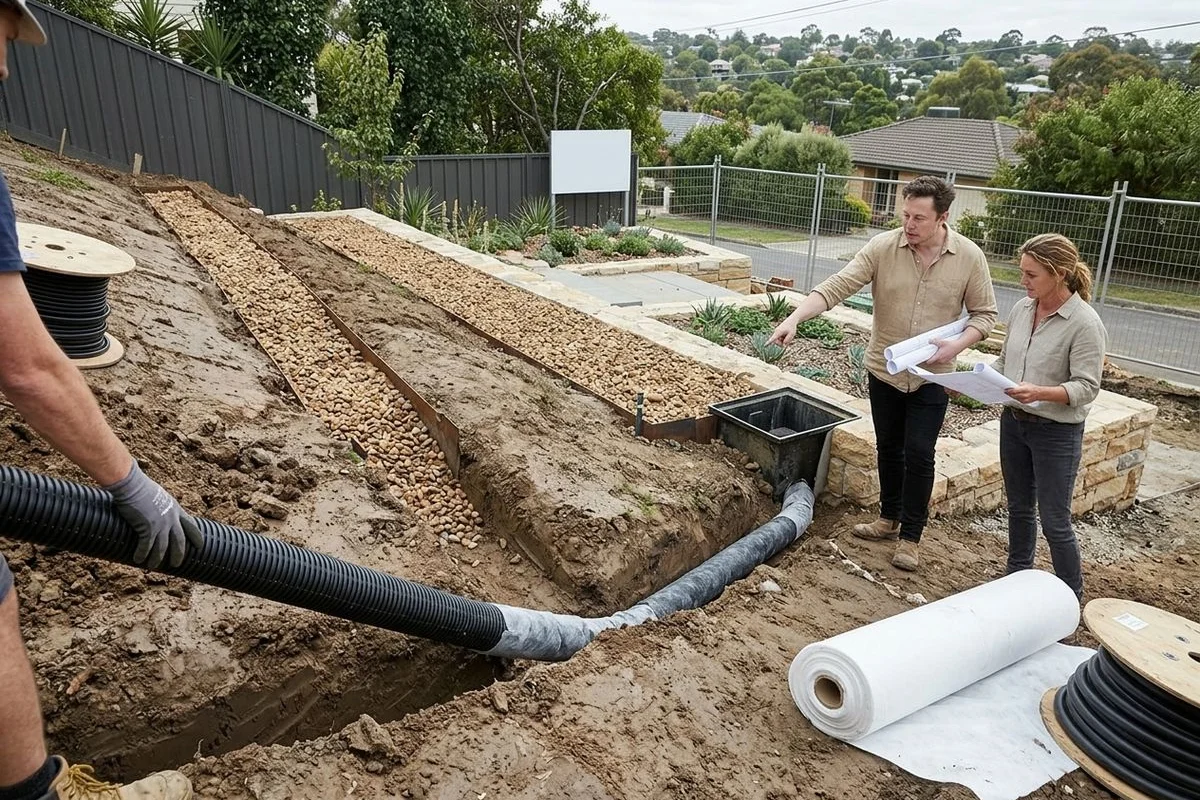
We implement a layered defence system to address different types of moisture simultaneously. A successful layout requires careful placement of specific components to ensure nothing is overwhelmed during a heavy storm.
| Drainage Component | Primary Function | Ideal Placement |
|---|---|---|
| Catch Drain | Blocks surface water from uphill neighbours | Highest elevated boundary line |
| Slotted Ag-Line | Relieves hydrostatic pressure in the soil | Directly behind all retaining walls |
| Field Drain | Dries out persistently soggy lawn patches | Across natural depressions in the yard |
| Inspection Pit | Captures sediment and provides access | Intersections every 10 to 15 metres |
| Sealed Pipe | Carries collected water off the property | Directed to the legal point of discharge |
Our preferred method integrates these elements into one cohesive system that protects the entire block. Missing even one of these layers leaves a hillside drainage design Melbourne project vulnerable to failure.
Design considerations
Proper hydraulic design is the difference between a functional hillside and a landslide waiting to happen. Managing velocity and providing regular maintenance access are the two most critical factors.
Managing Pipe Falls and Flow Velocity
Setting the correct pipe gradient ensures water flows away without destroying the infrastructure from the inside. Subsoil pipes require a minimum fall of 1:100 to keep water moving, but they can run as steep as 1:30 on significant inclines.
We install dedicated concrete drop-boxes to step the gradient down safely when dealing with severe slopes. Fast-moving water creates massive friction, violently eroding standard PVC components over time.
Our engineering layouts break the slope into manageable terraces to prevent this destructive speed buildup.
“Water flow exceeding 2 metres per second acts like a pressure washer inside your pipes, actively destroying joints on steep inclines.”
A controlled velocity guarantees the system will survive Melbourne’s unpredictable wet seasons.
Pit Spacing and Maintenance Access
A blocked pipe on a steep block causes rapid, unseen damage to the surrounding soil profile. Installing inspection pits every 10 to 15 metres is a strict requirement for ongoing maintenance.
We place these access points even closer together in heavily wooded areas where sediment and leaf litter loads are exceptionally high. Regular cleanouts prevent tree roots from finding their way into the nutrient-rich moisture inside the ag-lines.
Our teams use these pits to flush the system with high-pressure hoses during annual servicing. Here are the main signs your subsoil system needs immediate flushing:
- Unexplained damp patches appearing on lower lawn terraces.
- Silt and heavy mud building up inside the inspection pits.
- Water seeping directly through retaining wall blocks.
This simple access strategy saves thousands of dollars in excavation and replacement costs down the track.
Outfall Protection at Discharge
The point where concentrated stormwater exits the pipe requires heavy reinforcement to prevent massive soil loss. Installing a concrete headwall or placing large energy-dissipation rocks diffuses the water’s impact force effectively.
We always engineer these outfalls to comply with strict local government environmental guidelines. A raw pipe discharging directly onto a lower slope will quickly carve a deep erosion gully into the hillside.
Our comprehensive approach covers every aspect of a professional drainage design sloping block strategy. For detailed steep-block drainage, see our guide on drainage solutions for steep sloping blocks, or explore our general drainage service options to secure your property today.