We know that the hardest part of planning a major outdoor renovation isn’t picking the plants.
The real challenge is usually figuring out local council regulations.
Securing landscape council permits nillumbik and surrounding areas often dictates the entire project timeline.
Most projects across Nillumbik, Banyule and Manningham proceed without full planning approval.
We always establish which side of the line your property sits on during the initial consultation.
That early clarity separates a smooth build from a stalled one.
Our guide will break down the specific triggers for these three local areas.
Let’s review the practical ways to manage the approval process.
Permit triggers across the three LGAs
We evaluate local council overlays immediately because they dictate the exact rules for your build.
The major triggers for council intervention are retaining walls over 1 metre and significant earthworks exceeding 100 cubic metres.
High-quality structural engineers specifically account for the reactive Class M-H clay soils in Melbourne’s northeast when designing these structures.
Height limits vary with site conditions, so even lower walls on steep blocks might require council sign-off.
We see the following elements typically require council approval across all three municipalities:
- Retaining walls above 1 metre from the finished ground level.
- Significant earthworks involving a cut or fill greater than 100 cubic metres.
- Vegetation removal falling under the 2025 statewide Clause 52.37 regulations, which apply to trees taller than 5 metres.
- Overlay development located within a Significant Landscape Overlay, Bushfire Management Overlay, Heritage Overlay, or Environmental Significance Overlay.
- Pool construction and pool barrier compliance, which requires a separate building permit.
Application fees for these various approvals typically range from $150 to $500.
The final price depends heavily on the amount of documentation required.
Your final costs become clear after consulting with the local planning department.
Nillumbik: SLO and BMO the main considerations
We focus heavily on overlays in Nillumbik because it is the most heavily regulated municipality of the three.
The Significant Landscape Overlay blankets much of Eltham, Research, Diamond Creek, and North Warrandyte.
A significant landscape overlay nillumbik permit requires council consideration of native canopy and rural-residential context.
Our designers factor in these rules early.
This overlay does not prohibit construction, but specific schedules like SLO6 now require planning permits for nearly all buildings and works.
We always incorporate specific CFA requirements into the garden design for high-risk areas.
The Bushfire Management Overlay dictates low-flammability plant selection, clear access widths for fire trucks, and dedicated water supply tanks for firefighting.
The state 10/50 rule allows property owners to clear trees within 10 metres of the home and undergrowth within 50 metres without needing a separate permit.
We provide this quick comparison to clarify how different overlays impact your site:
| Overlay Type | Primary Focus | Practical Requirement |
|---|---|---|
| Significant Landscape Overlay | Visual amenity and canopy retention | Arborist reports and detailed planting schedules |
| Bushfire Management Overlay | Property defense and fire safety | Dedicated water tanks and non-combustible material |
These overlays ensure the region maintains its character while keeping residents safe.
Banyule and Manningham: more suburban, fewer overlays
We find that obtaining a landscape permit banyule is generally more straightforward because the area lacks the dense overlays of Nillumbik.
Greensborough, Ivanhoe, Heidelberg, and Lower Plenty sit mostly in standard residential zoning.
Our landscape designers make tree protection laws and height thresholds the primary focus in these suburbs.
Banyule is unique because it enforces permit requirements for tree protection across all residential properties.
We submit detailed arborist reports whenever working near trees listed on the Banyule Significant Tree Register.
The council currently charges a $226.90 application fee for tree removal, making early assessment crucial.
Managing Manningham’s Zoning Borders
Our designers approach Manningham properties with careful attention to specific zoning borders.
Doncaster and Templestowe share similar suburban zoning, but Warrandyte contains pockets of bush block overlays.
These specific pockets require thorough planning to satisfy both aesthetic goals and environmental regulations.
These Warrandyte sites receive the exact same caution as Eltham projects due to those localized rules.
How we manage the documentation
We manage the entire documentation process so you can focus on the exciting parts of the design.
Every new project begins with a comprehensive permit-status assessment during the concept phase.
Our team prepares the complete application package immediately if council approval is necessary.
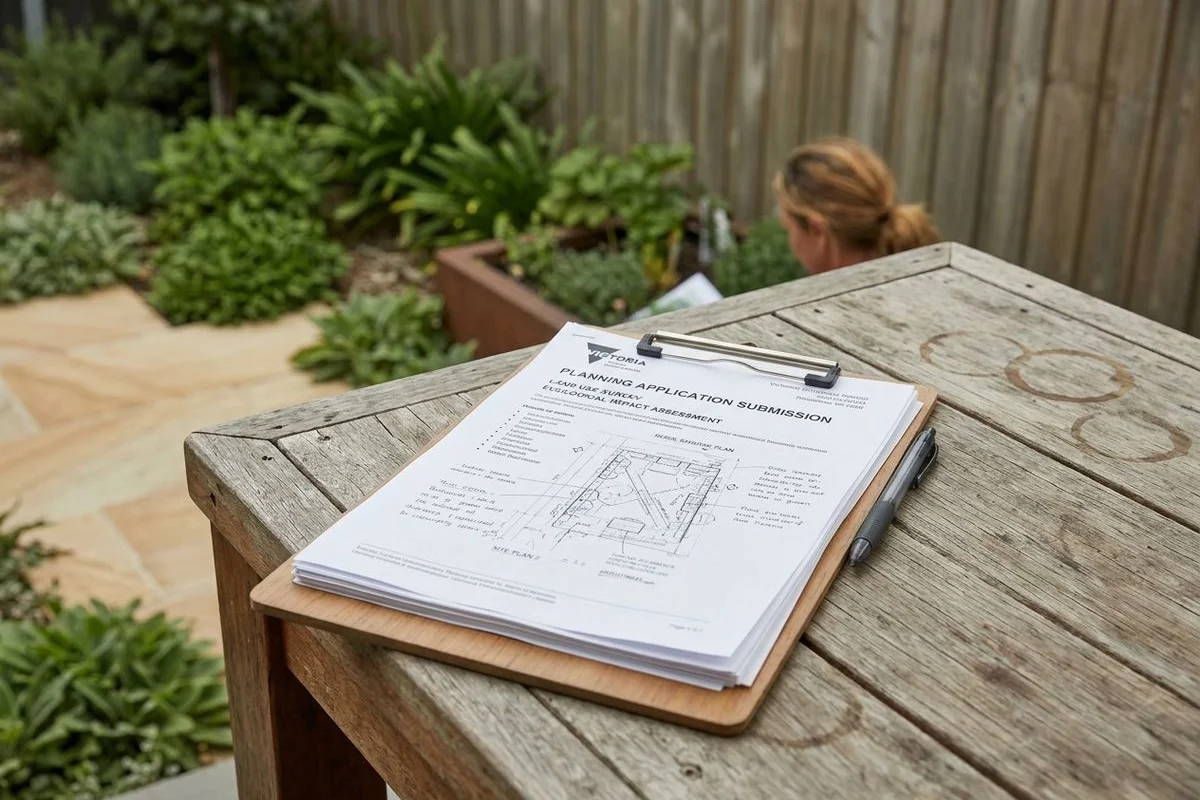
This typically includes a 1:500 scale site plan, 1:100 scale elevation drawings, and specific engineering reports.
We regularly lodge 05P applications in Nillumbik for single dwelling works, ensuring all paperwork meets exact municipal standards.
A comprehensive submission might also require a statement of effects for overlay-affected sites and a detailed plant schedule for the bushfire management overlay.
We liaise directly with the relevant council planner and coordinate with building surveyors for retaining walls and pool barriers.
This approach means owners face no chasing forms, no scheduling meetings with the council, and no guesswork about what will pass.
Required Application Documents
We compile several specific files for a standard council submission.
A successful application generally requires the following items:
- Scaled site plans showing natural ground levels and finished surface levels.
- Elevation plans detailing retaining wall heights, materials, and colours.
- Engineering reports for any structures built on reactive clay soils.
- Formal arborist assessments for any protected canopy trees.
Double-checking every dimension prevents costly requests for further information.
All necessary approvals are securely in hand by the time the construction team is ready.
Typical timelines
We build realistic timelines into your project schedule from day one to account for council processing.
The statutory timeframe for a council decision is 60 days, but requests for further information will pause this clock.
Proper planning explicitly budgets for these timeframes on overlay-affected sites.
Our standard timeline breakdown looks like this:
- Pre-application discussion (where needed): 2 to 4 weeks.
- Formal application lodgement to decision: 4 to 12 weeks depending on complexity.
- Building permit (retaining walls, pool barriers): usually concurrent with construction start.
- Post-build inspection and certification: 1 to 2 weeks at completion.
Active monitoring of the application status keeps the momentum going.
The build schedule remains reliable and realistic through every step.
Conclusion
We know the regulatory side of landscaping can seem overwhelming at first glance.
Proper preparation ensures your beautiful new garden becomes a reality without unnecessary stress.
You can secure your landscape council permits nillumbik efficiently with the right approach.
Our team is ready to bring your vision to life.
Contact David Claude Landscape Design today to schedule a consultation and start planning your perfect outdoor space.