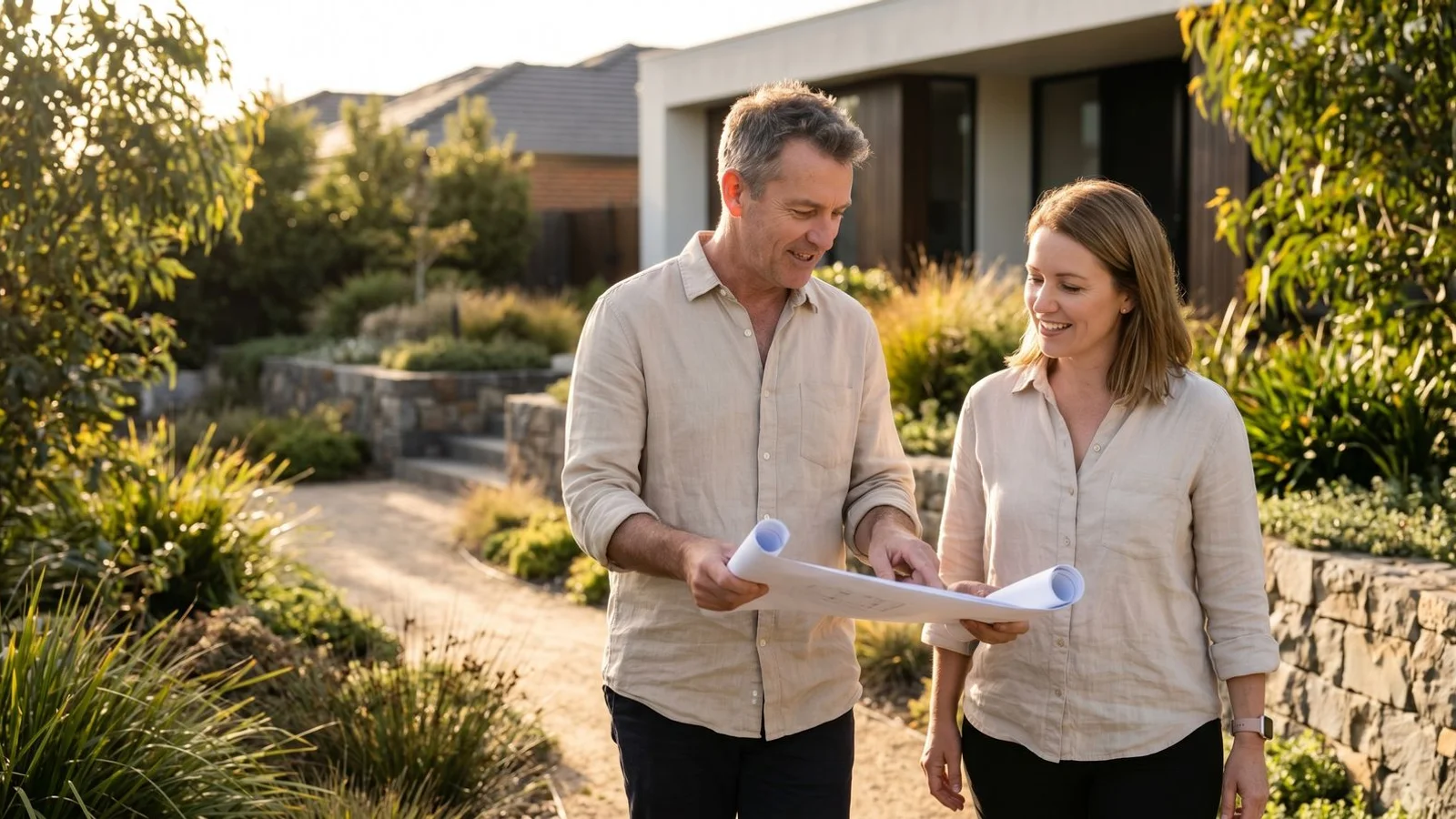
Taking a raw, sloped block from concept to completion requires more than just a good eye for plants.
Our team at David Claude Landscape Design knows that the landscape design build process is often the most misunderstood part of any property upgrade. Homeowners frequently underestimate the structural requirements of Melbourne’s terrain.
Reviewing the data behind site costs and unpacking the exact landscape project stages will help keep your timeline on track.
The five stages
Stage 1: Consultation (1 visit, ~2 hours)
We use this initial site walk to assess your levels, drainage, existing hardscapes, and the rough budget to determine project feasibility. The landscape consultation what to expect phase is really about uncovering hidden site constraints before they become expensive problems.
For properties in Melbourne’s north-eastern and inner-eastern suburbs, assessing local council overlays is the top priority. Our team actively looks for Vegetation Protection Overlays (VPO) or Significant Landscape Overlays (SLO), which are highly common in Boroondara and Banyule.
- Permit Requirements: Identifying SLOs or VPOs immediately.
- Terrain Challenges: Spotting severe slopes that require structural engineering.
- Budget Alignment: Matching your aspirations with current 2026 material costs.
- Timeline Reality: Setting expectations for design and construction phases.
Missing these details early on can stall a project for months. A standard VPO tree removal permit application currently costs around $226.90, but the real cost is the time delay if you aren’t prepared.
Stage 2: Design Proposal (4-8 weeks)
Our design phase translates your goals into a locked, structural plan ready for council approval. A professional contour survey is strictly required for sloping blocks.
We commission these detail surveys because accurate topography data prevents massive engineering blowouts later. Current 2026 data shows that detail and contour surveys in Melbourne typically start at $1,800, rising to $3,000 for complex sites with multiple structures or heavy vegetation.
| Survey Type | 2026 Average Cost (Melbourne) | Why It Is Necessary |
|---|---|---|
| Contour & Detail | $1,800 - $3,000 | Maps exact slopes and existing vegetation for design accuracy. |
| Title Re-establishment | $900 - $2,500 | Confirms exact legal boundaries before building structures. |
That initial investment is negligible compared to the cost of redesigning a retaining wall mid-build. Our concept plans go through two or three rounds to refine the layout, levels, and material direction.
Once the concept is agreed upon, the final planting plans and detailed construction documentation are developed.
Stage 3: Construction Quote (1-2 weeks)
We issue a detailed construction quote against the locked documentation to ensure complete transparency. Every material allowance is clearly defined, meaning no hidden contingencies are baked in quietly.
Our pricing models account for the volatile nature of current building supplies. Global copper prices surged 16.5% in early 2026, which directly impacts the cost of electrical services and premium outdoor lighting fixtures.
We also provide exact figures for structural elements like retaining walls, which are highly variable on challenging terrain. Depending on whether you choose timber, concrete sleepers, or masonry, retaining walls currently range from $200 to $1,000 per square metre.
Industry benchmarks show that for every extra metre of fall across a sloping building envelope, site-related costs increase by roughly $10,000 to $15,000.
Stage 4: Build (3-6 months)
Our dedicated team and trusted subcontractors handle the physical construction entirely under supervision. This single point of client contact prevents the crossed wires that frequently plague large, trade-heavy projects.
We manage the site cadence tightly, providing you with weekly updates and progress photos via project management software like NextMinute. Keeping all project data in one centralized app provides several immediate benefits:
- Clear Communication: Direct messaging between clients and site managers.
- Visual Updates: Weekly progress photos uploaded straight from the site.
- Weather Adaptability: Instant schedule adjustments for Melbourne’s unpredictable rain.
Our site managers ensure you will always know exactly who is on your property and what milestone they are completing that day.
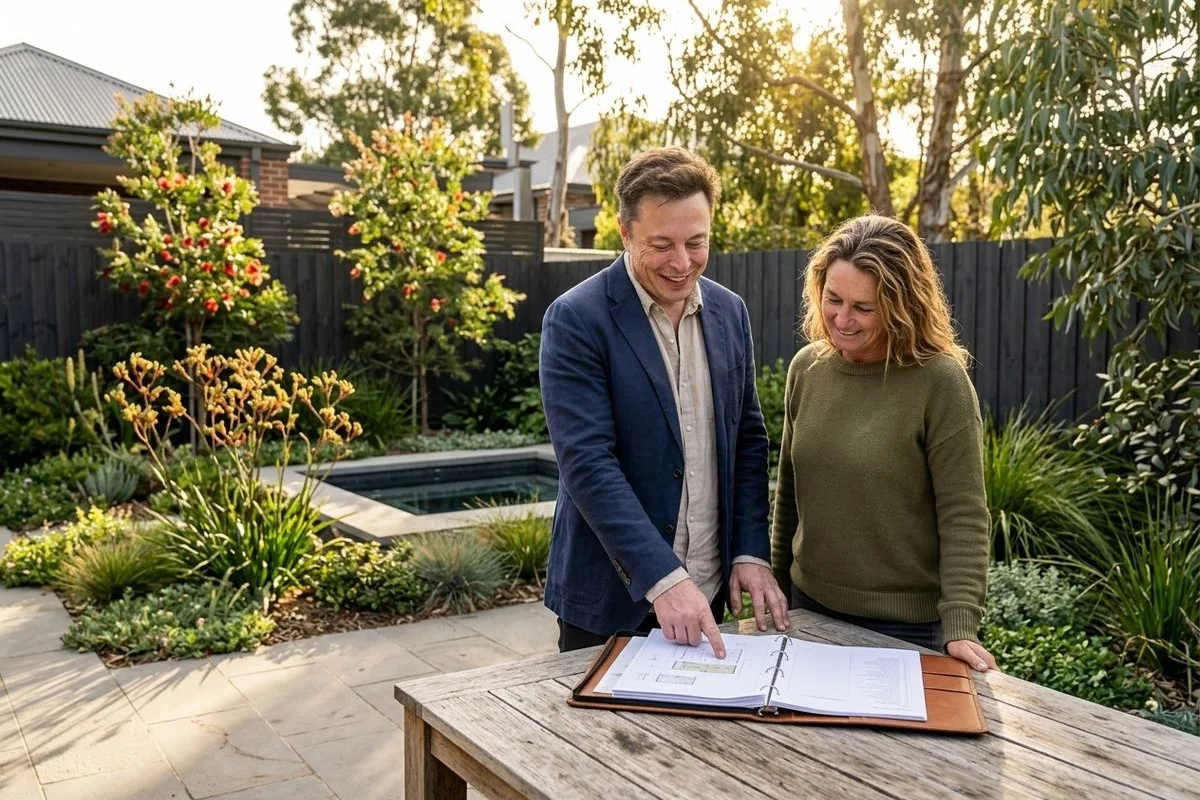
Stage 5: Handover (1 visit + establishment period)
We conduct a comprehensive walk-through of the finished garden to officially hand over the space. This visit includes providing detailed care notes, a full species list, and your warranty documentation.
Our commitment continues into the critical establishment period, with scheduled return visits at 3, 6, and 12 months. During these checks, the horticultural team inspects the planting and replaces anything that hasn’t taken root successfully.
We provide highly specific watering schedules adapted to Melbourne’s distinct seasons. For newly installed plants during the warmer months from November to April, standard practice requires dedicated hydration phases.
- Weeks 1 to 2: Light, daily watering focused directly at the plant base.
- Weeks 3 to 4: Deep watering every other day, monitoring soil moisture with the finger test.
- Months 2 to 12: Deep watering two to three times a week depending on rainfall.
After that initial phase, you must transition to deep watering to encourage deep root growth.
What owners tell us afterwards
The most common reflection from clients at handover is how quiet the process felt. We hear constant praise about the lack of surprises, missed communications, or panic over the budget.
This sense of calm directly stems from the continuity of having the same team manage everything from the first sketch to the final plant. Our integrated approach eliminates the friction of handing plans off to a separate, disconnected construction crew.
For a detailed breakdown of how these phases impact your specific schedule, the full timeline is covered here. We encourage you to review those timeframes and then reach out to schedule an initial site assessment.
Starting early is the best way to secure your ideal seasonal planting window.