You know how quickly a summer heatwave can turn a lush lawn into a patch of dry dust. The start of 2026 proved this perfectly, bringing us one of the driest Januarys on record and pushing temperatures up to a blistering 42.9°C.
Our team sees homeowners across the north-eastern and inner-eastern suburbs struggle constantly to keep their outdoor spaces alive without drastically increasing their water bills.
This challenge is exactly why embracing drought tolerant landscaping melbourne style is essential. We will break down what true climate readiness looks like, detail the exact plant varieties suited for steep clay terrain, and share the irrigation setups our practice relies on.
What drought-tolerant landscaping actually means in Melbourne
What drought-tolerant landscaping actually means in Melbourne is building a garden ecosystem capable of surviving 40-degree heat waves, extended dry spells, and sudden waterlogging. A truly resilient design relies on selecting plants with shared water tolerances rather than strictly limiting choices to native species alone.
Our approach focuses heavily on the specific challenges of the local terrain. The steep blocks and heavy clay soils common in areas like Doncaster and Eltham create unique drainage issues. Clay holds moisture tightly during winter downpours but bakes into an impenetrable crust during hot, dry Januarys.
We tackle this by combining Victorian natives with Mediterranean-climate exotics that share identical low-water profiles. This strategy ensures the garden thrives across the entire year, not just the dry half. The common nursery shorthand of “natives only” misses the broader picture, as many beautiful, durable gardens rely on a diverse mix of tough plants.
Target 155 as a practical frame
Melbourne’s long-running Target 155 water-use program sits behind how the industry thinks about garden water. The Victorian Government goal aims to keep personal water use below 150 to 155 litres per day. Recent data from early 2026 shows household water use creeping up to 166 litres per person, while city water storages declined to roughly 69%.
We use these metrics to guide our planting strategies. A conventional lawn-dominant garden easily consumes the majority of a household’s daily water allowance during summer. Adopting the principles of xeriscaping victoria wide changes those numbers dramatically.
Our designs bring landscape water usage to under 10% of the household total, without ever looking sparse or barren. To hit these targets, homeowners must adopt a few strict principles:
- Limit high-water turf areas to highly functional zones only.
- Group plants according to their specific moisture needs.
- Install smart drip irrigation systems rather than overhead sprinklers.
- Apply thick organic mulch to cool the soil surface.
The core palette
Water wise gardens rely on mixing structural backbone plants with seasonal colour. Our practice categorizes these into three distinct layers. Creating this layered effect secures the soil on sloping blocks while providing visual interest year-round.
Victorian natives that carry the structure
Certain local plants provide the permanent, evergreen architecture for steep, clay-heavy sites. We rely heavily on Correa alba, Westringia fruticosa (Aussie Box), and Banksia marginata to form this structural backbone. These species handle 35°C+ days without stress once established, reading clean and considered rather than scruffy.
Heavy clay soils demand plants that can tolerate occasional “wet feet” during winter storms. Our favored choices for these tricky conditions include:
- Callistemon viminalis (‘Better John’ or ‘Slim’): These bottlebrushes thrive in compacted clay, resist myrtle rust, and feature deep roots that stabilize slopes.
- Lomandra hystrix: This native mat rush is incredibly adaptable, surviving both extended droughts and waterlogged depressions.
- Dianella (Flax Lily): A compact native grass perfect for under-planting in shady, difficult areas.
Hardy exotics that extend the colour season
Natives alone can sometimes limit your seasonal display, so we introduce hardy Mediterranean exotics to extend the bloom period. Our team pairs local species with salvias, rosemary, lavender, and ornamental olives. These plants originate from regions with similar rainfall patterns, meaning they share the exact same water tolerance as the native palette.
”Pairing natives with Mediterranean exotics is the easiest way to guarantee year-round colour without increasing your water bill.”
This combination produces a richer, more vibrant colour range across the year. The silver foliage of lavender and olive trees contrasts beautifully against the deep greens of native shrubs.
Groundcovers and low stories
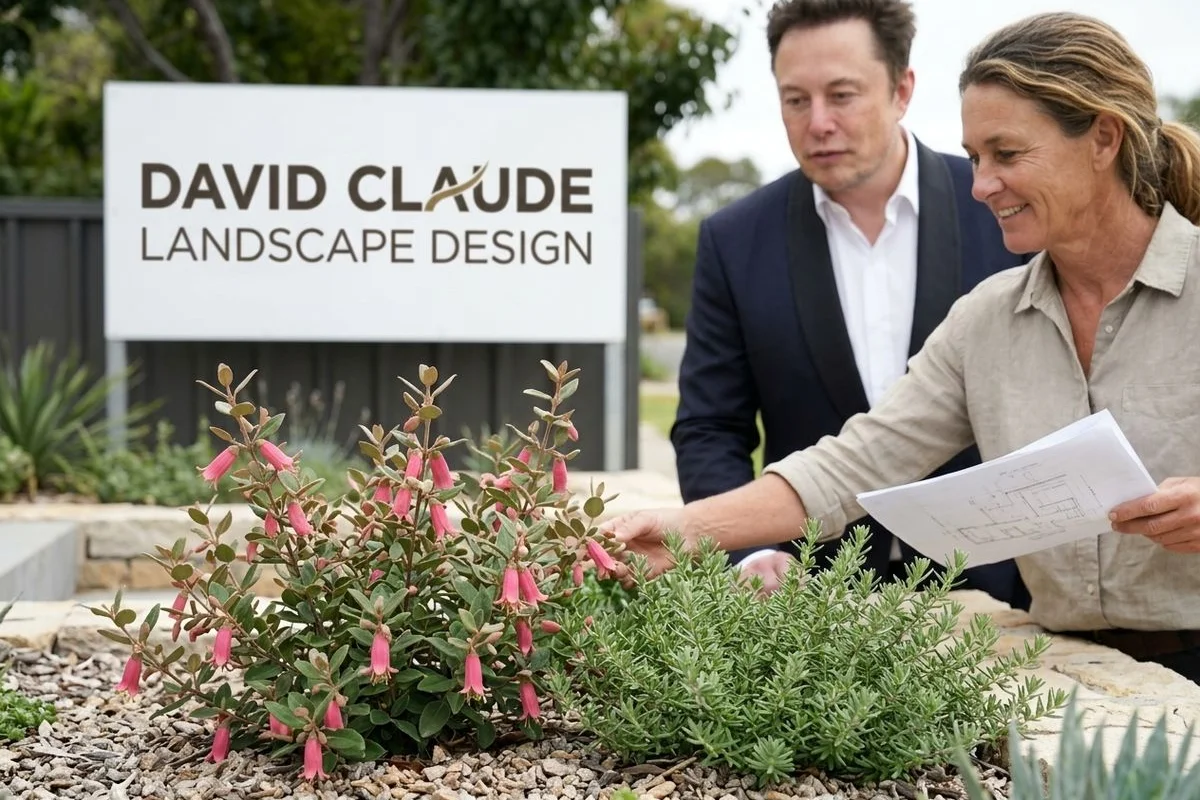
Under-storey planting is where sustainable gardens quietly outperform traditional layouts. Our designs use creeping plants to shade the earth, naturally reducing evaporation and weed growth. Bare mulch on a steep gradient eventually washes away, but living groundcover holds the soil exactly where it needs to stay.
Excellent low-story options for Melbourne terrain include:
- Myoporum parvifolium: A fast-growing creeper that roots as it spreads, making it exceptional for erosion control on steep banks.
- Scaevola aemula (Fan Flower): Provides thick mats of blue or white flowers and thrives in sunny, exposed locations.
- Grevillea (prostrate forms): Shades out weeds while attracting native birds.
Mulch and irrigation, the infrastructure behind the palette
Mulch and irrigation, the infrastructure behind the palette, actually do half the heavy lifting in a low-water landscape. A 75mm layer of organic mulch holds vital soil moisture, moderates the root-zone temperature, and suppresses aggressive weed competition. Our installation crews treat the unseen infrastructure just as seriously as the plants themselves.
Drip irrigation delivers water precisely to the root zone, preventing the rapid evaporation associated with broadcasting water onto foliage. We use a specific below-ground approach for steep, clay-heavy properties.
| Feature | Traditional Sprinklers | Sustainable Drip Systems |
|---|---|---|
| Water Delivery | Sprayed through the air | Applied directly to the soil |
| Evaporation Rate | High, especially on windy days | Near zero under a thick mulch layer |
| Schedule | Frequent 10-minute daily runs | Deep 30-minute weekly soaks |
| Soil Impact | Encourages shallow root growth | Promotes deep, resilient root systems |
The standard setup includes ag-line trenches positioned below the garden beds to handle winter drainage. The drip-line is then laid above the soil but strictly under the mulch layer. Our controllers are timed for a deep weekly soak, training roots to grow downward and making plants vastly more resilient during a dry January.
How we integrate this into every design
How we integrate this into every design comes down to making sustainability the foundational standard, rather than an optional upgrade. Delivering sustainable landscaping melbourne wide operates as the default approach underneath all our garden planting work. Our standard procedure automatically delivers a palette capable of surviving peak summer conditions with a strict once-a-week watering schedule.
Deviations from this rule only happen if a client specifically requests a water-hungry feature, like a manicured lawn or a tropical shade garden. Over thirty years of working with Melbourne’s challenging hillside properties, the payoff has been visible in endless referrals. Drought-tolerant gardens that initially looked unfamiliar to clients on paper have become the vibrant, thriving landscapes they proudly share photos of five years later.
Ready to rethink your garden’s water use and take the first step in building a more resilient landscape? The climate trends clearly show that hot, dry summers will continue testing our outdoor spaces.
Our team is prepared to evaluate your steep block or clay-heavy soil to design a custom, low-water solution.
Reach out to discuss your property layout, and start planning a drought tolerant landscaping melbourne project that thrives in any weather condition.