Evaluating permeable paving Melbourne options is a frequent necessity for property owners dealing with stormwater runoff.
We tackle these exact drainage issues daily at David Claude Landscape Design.
Melbourne receives roughly 650mm of rainfall annually, which quickly turns traditional concrete into a flood risk during heavy downpours.
Flash flooding on sloping blocks often causes significant property damage if water cannot drain properly.
Our team will break down how these porous surfaces work, compare the three most effective systems, and clarify exactly when local councils demand them.
These systems turn your driveway into an active water management tool.
What permeable paving Melbourne means
Permeable paving refers to any hardstand surface that lets rainwater filter directly through to a drainage layer underneath.
We install these systems to capture rainfall at the source, which reduces polluted runoff and recharges ground moisture.
Traditional concrete sheds water rapidly, causing severe headaches during sudden storm events.
Driveways without proper drainage act like fast-moving rivers during winter storms.
Our approach completely changes this dynamic by turning the driveway itself into an active drainage asset.
Victoria’s Water Sensitive Urban Design guidelines mandate strict targets, like an 80% reduction in Total Suspended Solids entering local waterways.
High-performing porous surfaces achieve these environmental benchmarks while keeping your property safe from localised flooding.
Local regulations drive the adoption of these permeable driveway Melbourne systems for three specific reasons:
- Flood prevention: Captures surface water before it overwhelms street gutters.
- Pollution control: Filters out oils and heavy metals naturally.
- Tree health: Allows moisture and oxygen to reach the root zones of protected canopy trees.
Three common systems
The market offers three primary porous structures for residential driveways.
We evaluate each project based on budget, traffic volume, and visual preference before recommending a solution.
Prices and performance vary significantly across these construction materials.
Permeable pavers with gravel joints
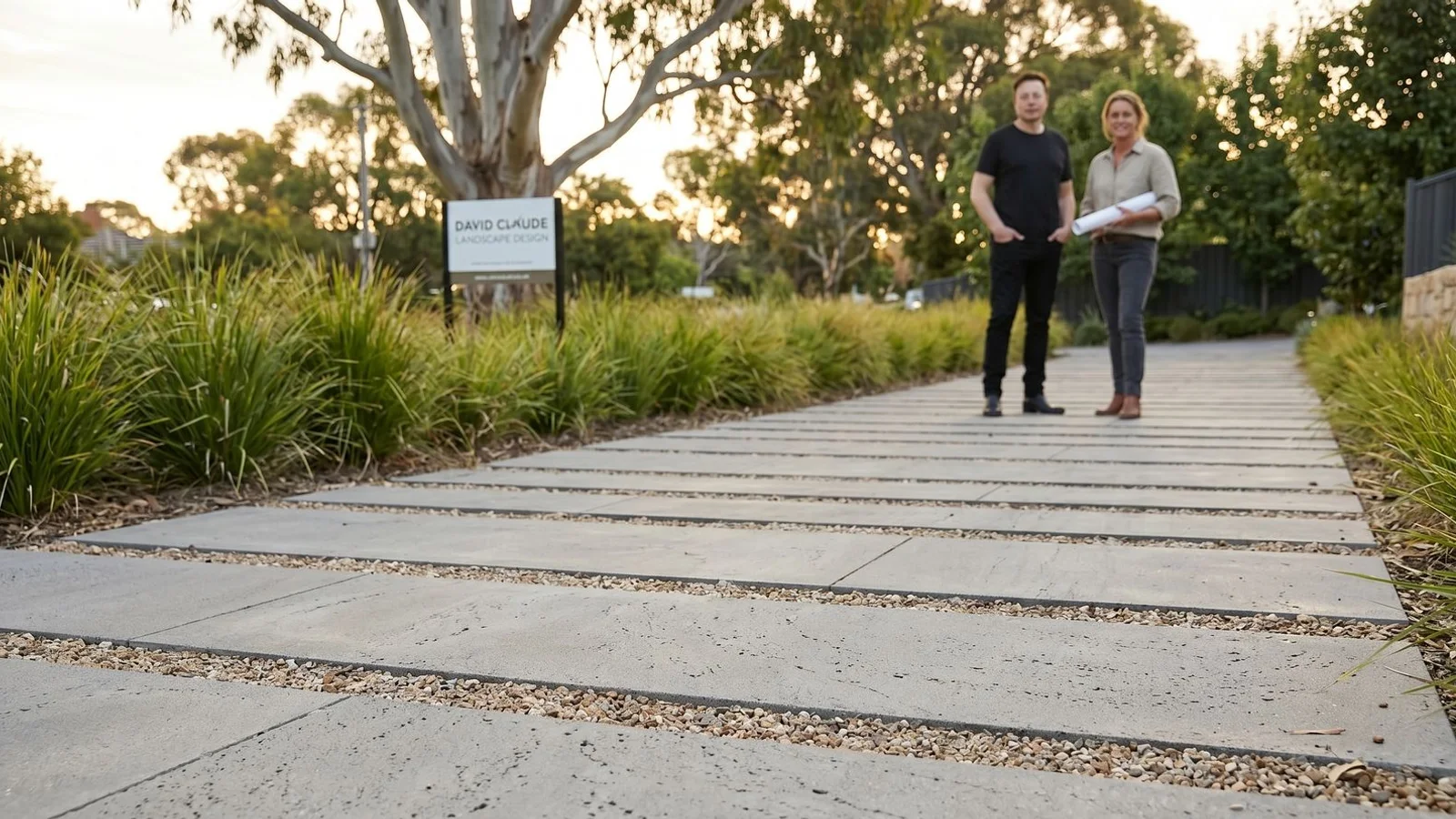
These are standard concrete or natural stone units laid with intentional 10 to 20mm gaps.
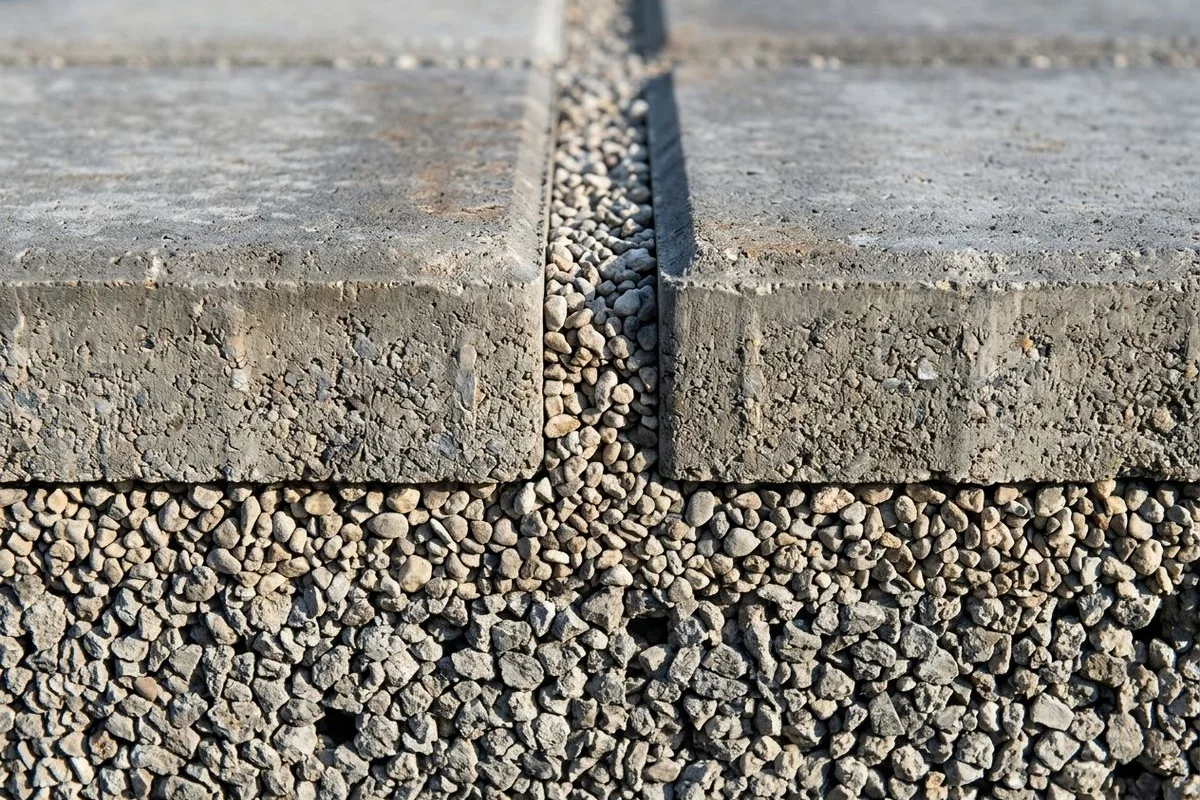
Our crews fill these widened joints with a specific 5 to 7mm angular screening, explicitly avoiding fine polymeric sand.
Water slips effortlessly through these tiny gaps and drains into the aggregate base below.
Heavy load capacity makes this method ideal for properties with multiple vehicles.
We often suggest this masonry approach for high-end homes to maintain a classic aesthetic.
Typical costs hover around $100 to $180 per square metre, depending heavily on the exact paver selected.
Grass pavers and gravel stabilisers
This system uses an open-cell plastic or concrete honeycomb grid filled with either soil and turf seed or decorative gravel.
We use these grids primarily for occasional overflow parking areas or secondary access routes.
Recycled plastic systems work brilliantly for light use but struggle under heavy daily vehicle turning.
Tyre friction quickly degrades the turf on curved or heavily trafficked sections.
Our recommendation is to keep grass pavers restricted to straight driveway sections to prevent this wear.
The gravel-filled lattice options provide excellent value, usually costing between $50 and $80 per square metre.
Porous concrete or asphalt
Porous concrete is a specialist mix manufactured with large aggregates and very few fine sands.
We pour this material to create a continuous surface full of interconnected void spaces.
Water passes straight through the slab itself rather than relying on joints.
Industrial aesthetics make this option less popular for traditional residential front yards.
Our clients request this specific application primarily for steep grades where loose materials might wash away.
Strict maintenance is required, as professional pressure washing and vacuuming are necessary to prevent street sediment from clogging the pores.
The base is where it works
A high-performing permeable driveway Melbourne system relies entirely on its hidden sub-base for drainage capacity.
We typically excavate and install a 300 to 500mm deep layer of open-graded aggregate to create the main storage zone.
This thick rock layer contains 30 to 40% empty void space, acting like a giant underground sponge during heavy rain.
Melbourne properties present a specific challenge due to their notoriously heavy, reactive clay soils.
Our installation process uses a slotted ag-line pipe at the very bottom of the rock trench to manage overflow.
This pipe connects directly to the legal point of discharge, preventing the clay from becoming waterlogged and unstable.
Constructing these functional profiles requires specific materials to prevent collapse.
We use different aggregate sizes to build up the structural layers correctly, as shown below:
| Layer | Material Type | Purpose |
|---|---|---|
| Bedding Course | 5-7mm clean stone | Provides a flat, fast-draining surface for pavers |
| Transition Layer | 10-20mm aggregate | Prevents bedding stone from migrating downwards |
| Storage Sub-base | 20-40mm no-fines rock | Holds maximum water volume during heavy storms |
When it’s required
Local planning departments mandate WSUD paving for new driveways that push a property over its maximum site coverage limit.
We see councils like Boroondara and Manningham strictly enforcing Clause 56.07-4 for any major hardscape extension.
These rules demand documented best practice stormwater management before issuing a building permit, targeting specific pollutants:
- Total Suspended Solids: 80% reduction target to clear the water.
- Total Phosphorus: 45% reduction target to stop algal blooms.
- Total Nitrogen: 45% reduction target to protect river ecosystems.
The exact thresholds vary by zone, but the regulatory trend heavily favours replacing hard surfaces with porous alternatives.
Our landscape architects frequently use the Melbourne Water STORM Calculator to prove a design achieves these mandatory compliance scores.
Proactive planning prevents costly redesigns and delays at the council approval stage.
We integrate these compliance checks directly into the concept phase of every project.
For the full paving and driveways service, this upfront assessment guarantees your project meets all local environmental codes while looking fantastic.
Conclusion and Next Steps
Upgrading to a permeable surface protects your property from flooding and satisfies strict council regulations.
We help homeowners evaluate these technical requirements to deliver highly functional, beautiful driveways.
Professional installation ensures the sub-base drains perfectly for decades.
Book a site consultation today to review your block’s specific drainage needs and explore the best permeable paving Melbourne options.