We know that driving up a steep driveway on a hill shouldn’t feel like an off-road adventure. The constant scraping at the street apron usually means your slope violates standard local council rules.
Our team at David Claude Landscape Design provides premier landscape architecture, design, and construction services built for the specific needs of every homeowner. Mastering sloping driveway design Melbourne projects requires understanding the exact numbers behind safe gradients.
We will also review the drainage layouts necessary for heavy rainfall.
Gradient limits in sloping driveway design Melbourne
A driveway gradient limit dictates the maximum allowable slope for safe vehicle access under the Australian Standard AS 2890.1. We typically cap standard residential ramps at a 1:4 maximum gradient to prevent cars from bottoming out. Steeper angles create serious grip challenges during sudden rainstorms.
Here are the specific gradient thresholds for a standard passenger vehicle:
- Comfortable: 1:8 (12.5%) or less.
- Normal steep: 1:5 to 1:6 (16 to 20%).
- Maximum: 1:4 (25%) with transitions.
- Above 1:4: Requires highly specialized transition design to avoid car-grounding risks.
Victorian planning codes require strict controls to ensure a steep driveway gradient remains safe. Our engineers often maintain a gentle 1:20 (5%) slope for the first 6 metres from the street boundary. This flat zone allows standard B99 passenger vehicles to enter safely without scraping the pavement.
Transition curves
Transition curves are the gradual flattening zones located at the street apron or garage entry. We use swept path analysis software like AutoTURN to mathematically calculate these angles. Without properly designed transition curves, the undercarriage of a standard vehicle will violently scrape the pavement.
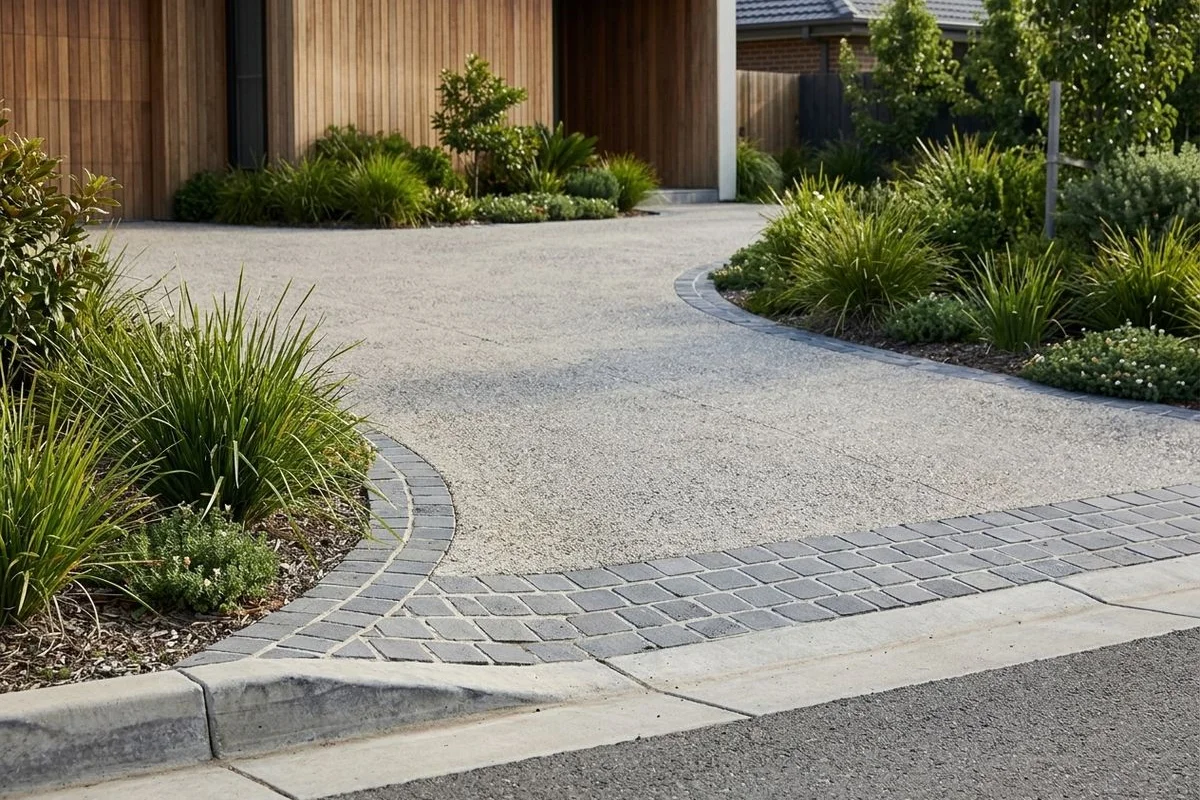
A standard curve requires between 4 and 8 metres of space. Our designers plot 10-metre transitions on severely steep blocks across Melbourne’s north-eastern suburbs. This extra length provides a comfortable buffer for low-clearance vehicles.
| Driveway Steepness | Gradient Ratio | Recommended Transition Length |
|---|---|---|
| Moderate Slope | 1:8 to 1:6 | 4 metres |
| Steep Slope | 1:5 to 1:4 | 6 to 8 metres |
| Severe Slope | Above 1:4 | 10+ metres |
Local council regulations demand precision in these specific measurements. We always verify these dimensions before pouring any concrete. Getting the curve right prevents thousands of dollars in vehicle damage.
Surface material on slopes
Choosing the right surface material is the most effective way to prevent slipping on a steep hill. We highly recommend exposed aggregate for properties across the inner-eastern suburbs. The Australian Standard AS 4586 defines specific slip resistance ratings for outdoor surfaces.
- Exposed aggregate: The most common choice in Victoria. A 10mm to 14mm exposed stone mixture easily achieves a P4 slip rating.
- Textured concrete (broomed, banded): A cost-effective option. The rough broomed finish delivers reliable grip for standard passenger cars.
- Bluestone pavers on concrete base: Offers a premium look. These pavers provide solid grip only when specifically flamed or textured.
- Gravel: Highly unstable on steep terrain. It washes out easily and is not suitable for gradients above 1:10.
Materials like smooth concrete or glazed tiles lack adequate traction and should never be used on a sloped driveway.
Maintaining surface traction
Our residential projects aim for a P4 or P5 slip rating to guarantee grip during heavy rainfall. Using a high-strength 25 to 32 MPa concrete base ensures the pavement survives intense summer heat without cracking.
We apply professional anti-slip sealers to maintain this traction year after year.
Regular pressure washing prevents slippery algae buildup during the damp winter months.
Drainage on a sloping driveway
Proper drainage intercepts fast-moving water before it floods your garage or the public street. We install high-capacity polymer concrete trench systems to capture this rapid runoff. Water running down a steep driveway gathers intense speed during sudden downpours.
A typical sloping driveway requires two to three channel drains positioned strategically across its length to manage stormwater effectively.
Our preferred solution is the ACO Drain system, which uses a specialized V-profile to handle severe weather events. These durable, grated drains route the excess water directly into the municipal stormwater network.
Strategic drain placement
We position these cross-drains at the top of the transition curves to break up the water’s momentum. This targeted placement protects the structural integrity of the entire pavement. Failing to install adequate drainage causes severe erosion beneath the concrete slab.
Next steps for your property
We offer a dedicated sloping block service for integrated slope-site design.
To explore full property transformations, review our paving service which covers extensive driveway installations.
Getting your sloping driveway design Melbourne project right the first time ensures long-term safety and adds massive value to your property.