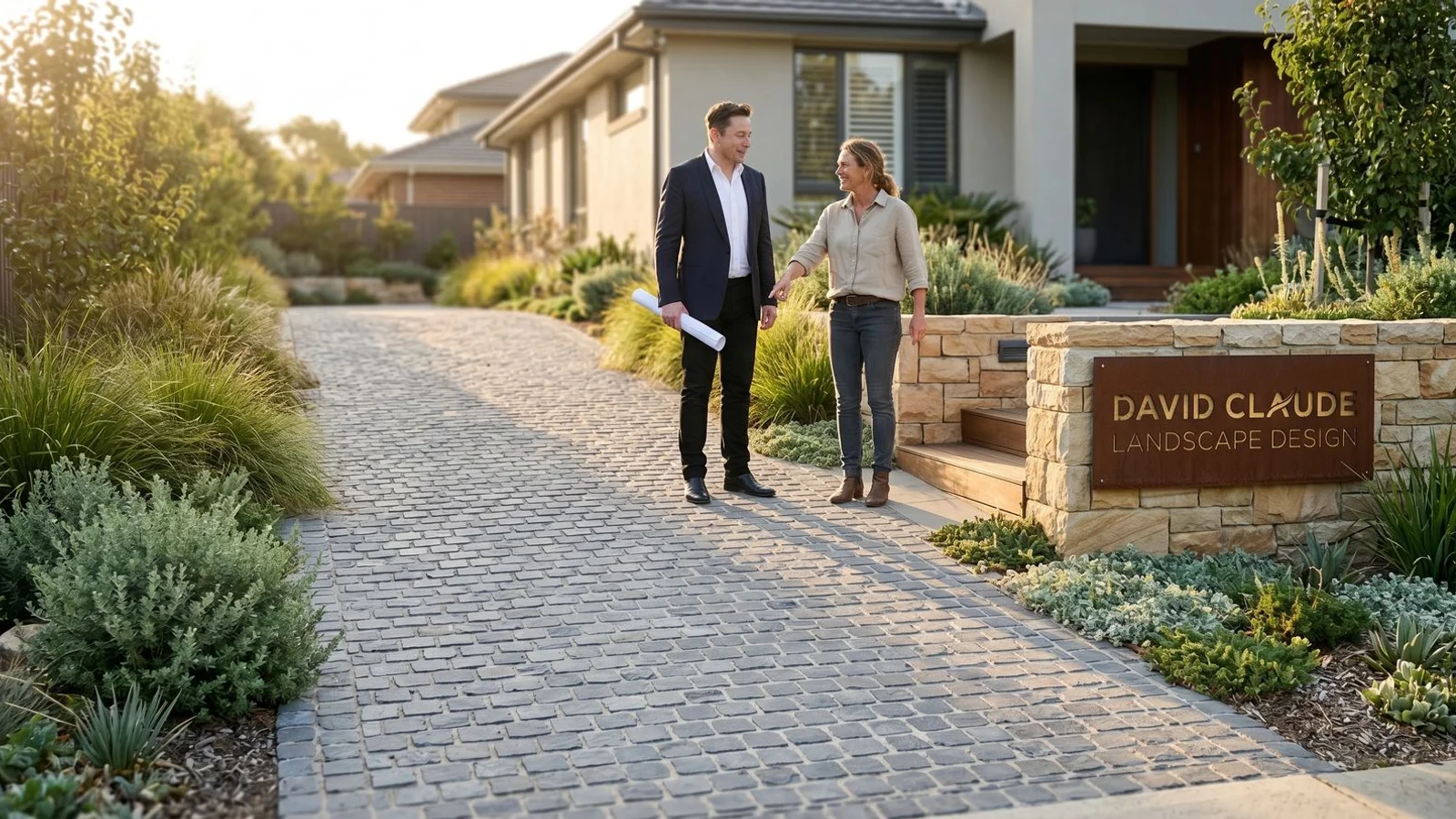
Upgrading your property access is a major financial decision for any homeowner. From what I’ve noticed, the difference between a driveway that lasts decades and one that cracks in two years comes down to unseen base preparation. We constantly track the average driveway cost Melbourne contractors charge to ensure our estimates reflect the current market.
Understanding the typical paving cost Victoria per m2 helps you make a clear, data-driven choice for your property.
Let’s break down the realistic prices for 2026 and review the specific council requirements you need to know.
Installed paving cost Victoria per m2
For a standard plain concrete driveway in Melbourne during 2026, prices generally sit between $90 and $140 per square metre. If you are looking for heritage appeal, the bluestone paving price ranges from $250 to $430 per square metre depending on the finish.
We update these figures based on current supply chain realities and quarry prices.
Your final bill will fluctuate based on the specific material chosen and your block’s topography. A sloping surface naturally increases labour time and requires extra materials. You should expect to pay a surcharge of roughly $10 to $15 per square metre if your property has a steep incline.
| Paving Material | Estimated Cost (per m²) | Best Used For |
|---|---|---|
| Gravel (compacted road base) | $40 to $80 | Budget-friendly long driveways |
| Concrete (plain/broomed) | $90 to $140 | Standard residential access |
| Exposed aggregate | $120 to $200 | Decorative, high-grip surfaces |
| Sandstone | $200 to $380 | Feature paths and patios |
| Travertine (filled and honed) | $200 to $380 | Pool surrounds and modern entries |
| Bluestone paving (honed) | $250 to $400 | Premium smooth finishes |
| Bluestone paving (sawn/flamed) | $280 to $430 | Classic Melbourne heritage homes |
These installed costs include basic base preparation, edge restraints, standard jointing, and standard drainage integration.
Factoring in Melbourne’s Terrain
Many properties in the north-eastern suburbs sit on highly reactive Class H clay soils.
This type of ground expands and contracts wildly between wet winters and dry summers. We always specify heavy-duty base stabilisation to counteract this aggressive soil movement.
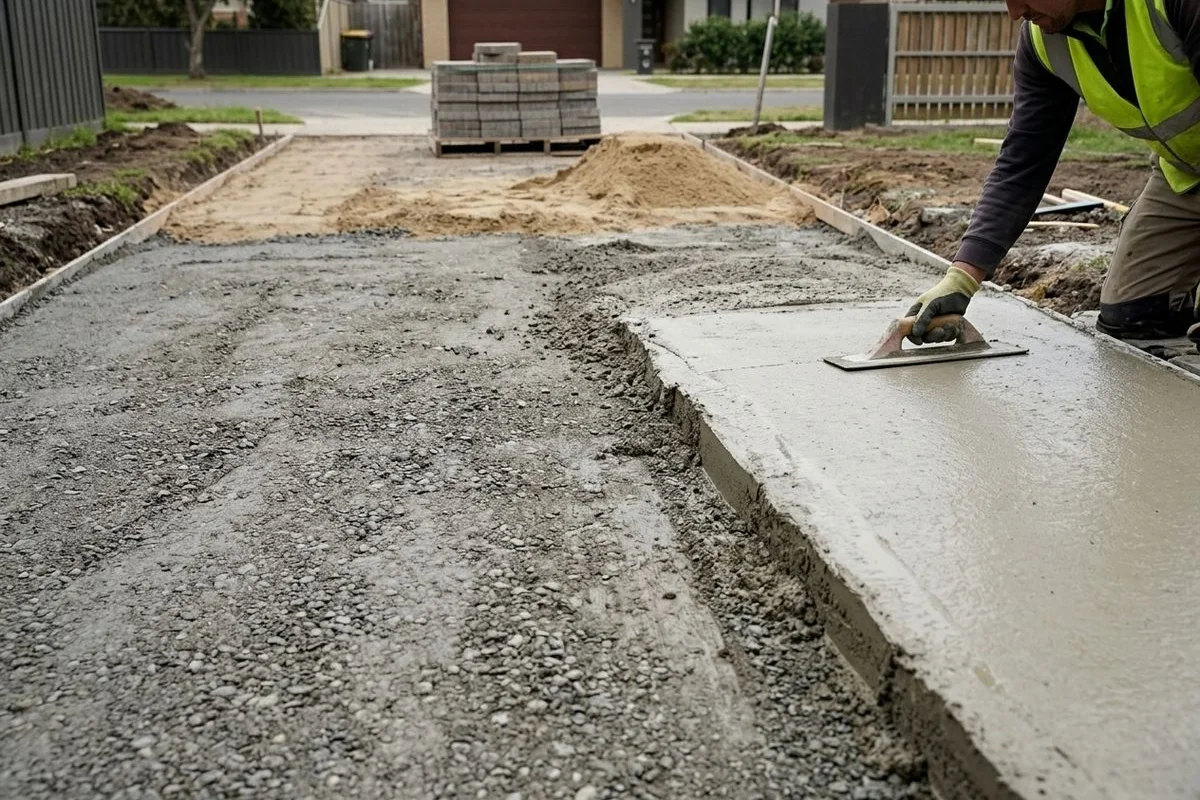
Cutting corners on the sub-base leads directly to surface cracking and subsidence within a few short years. A proper, long-lasting installation requires specific crushed rock depths and intense mechanical compaction.
What’s included at our rate
Our standard rate covers the complete installation process, including full excavation, compacted road base preparation, and final jointing. You receive a fully compliant, durable surface with integrated drainage designed to withstand heavy daily use.
We manage all the technical heavy lifting and earthmoving so you can focus on the final aesthetic.
Standard Base Preparation
Local council regulations dictate strict guidelines for any new driveway construction.
A standard vehicle crossing in the Banyule area requires a total minimum excavation depth of 200mm. Installers must lay 150mm of poured concrete directly over 50mm of compacted fine crushed rock.
Here is exactly what falls under our standard pricing structure:
- Excavation to design depth (usually 200 to 300mm for driveways, 150 to 200mm for paths)
- Installation of compacted road base (150 to 200mm)
- Screed bed preparation (20 to 30mm)
- Concrete haunch or spine beam edge restraints
- Complete material supply and professional installation
- Polymer sand or mortar jointing with drainage tie-ins
Structural Reinforcement
A lasting driveway needs serious steel reinforcement to handle the weight of modern vehicles. Installers use heavy-duty steel mesh to prevent the concrete slab from flexing and snapping under pressure.
Standard residential setups across Victoria generally use F72 reinforcing mesh. Workers set this steel on specific bar chairs before pouring the concrete to ensure it sits perfectly in the middle of the slab. Heavier commercial applications or driveways housing large caravans might require thicker F82 steel mesh for extra structural integrity.
Cost extras
You should anticipate additional fees for council permits, difficult site access, and special heritage overlays. These mandatory extras can add several hundred to a few thousand dollars to your total project budget.
We always identify these potential costs during our very first site visit.
This upfront transparency prevents frustrating budget blowouts later in the project. Knowing exactly what the council expects allows you to plan your finances accurately.
Council Permits and Compliance
Local councils strictly control any work that connects your private property to the public road network. A vehicle crossing permit is a mandatory requirement for any new, altered, or temporary driveway crossover. The Boroondara Council charges a $370.50 fee for a temporary permit, which covers both the pre-pour and follow-up inspections.
Permit structures and pricing vary significantly between different local government areas. The Banyule Council charges a $119.20 application fee alongside a $161.00 inspection fee.
Contractors completing these crossover works must also hold a valid certificate of currency for public liability insurance. Boroondara requires a minimum $10 million policy, while Banyule mandates a strict $20 million minimum coverage limit.
Site-Specific Surcharges
Every individual property presents a unique set of logistical and geographical challenges. You will need to account for these specific upgrades if they apply to your block:
- Crossover works (street apron): Expect to pay $2,500 to $6,000 for the physical construction on council land.
- Steep-site access surcharge: Hard-to-reach areas require an extra 15 to 25 percent premium for manual labour and specialized equipment.
- Permeable paving upgrade: Adding eco-friendly drainage solutions costs an extra $30 to $60 per square metre.
- Heritage matching: Sourcing specific traditional materials to satisfy local overlay rules adds a 10 to 30 percent surcharge.
A solid, well-built driveway adds massive street appeal and genuine value to your property. Choosing the right material and ensuring proper council compliance are the biggest hurdles you will face during the planning phase.
We structure our quoting process to outline the complete paving cost Victoria per m2 clearly from day one.
To benchmark these numbers against other landscape categories, see our construction cost guide, or review the paving service page for a detailed build scope.
Ready to get a precise figure for your specific block? Contact our team today to schedule a site assessment and start planning your new driveway.