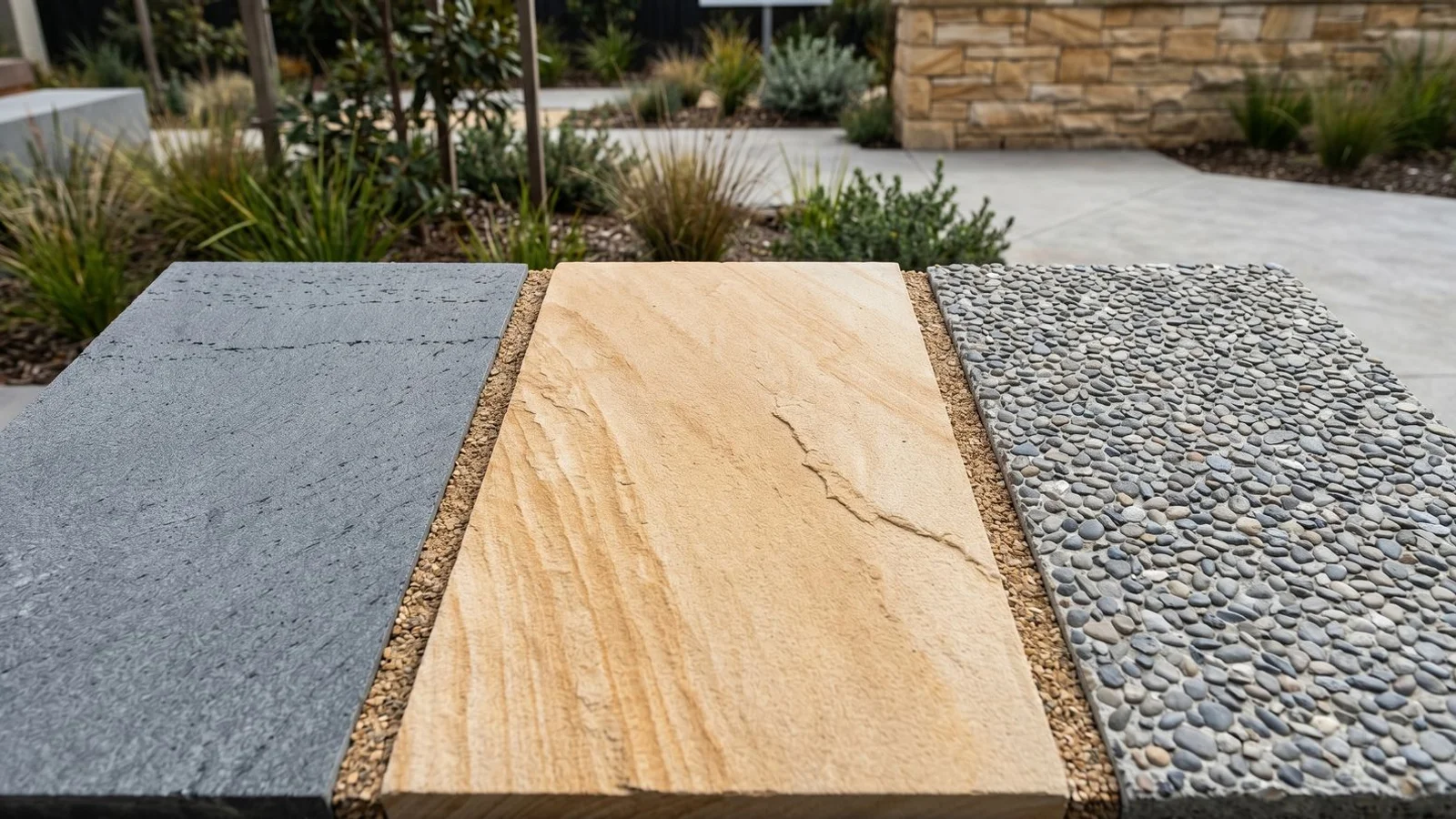
We frequently see homeowners struggle to balance aesthetics with the realities of Melbourne’s reactive clay soils. That makes the bluestone vs sandstone vs exposed aggregate debate a critical starting point for any landscape project.
This choice directly impacts both daily safety and long-term property value.
Our team at David Claude Landscape Design has engineered solutions for sloping blocks across the inner-eastern suburbs. The recent 2026 industry data shows that choosing the right base prevents severe drainage failures.
A thorough Melbourne paving material comparison will save you thousands in future repairs.
Our goal today is to break down the exact costs and performance metrics for each option. Let’s examine the durability ratings and specific use cases to help you make a confident decision.
You will see exactly which option serves as the best driveway material for challenging terrain.
Bluestone vs Sandstone vs Exposed Aggregate: Three Materials at a Glance
We evaluate these three surfaces based on cost, slip resistance, and lifespan. Bluestone offers maximum strength, sandstone provides natural cooling, and exposed aggregate delivers cost-effective traction. Each material requires specific preparation to survive the ground movement common in suburbs like Mont Albert and Glen Waverley.
Bluestone
Our installers highly recommend Victorian bluestone for properties requiring extreme durability. This dense volcanic rock boasts a massive 120 MPa compressive strength. That rating means it easily handles heavy vehicles without cracking.
We source premium bluestone to ensure a consistent, classic Victorian grey look. The stone features an R11 to R13 slip resistance rating. This high traction makes it incredibly safe for wet areas and steep inclines.
- Cost: $150-$250 per m² supply; $250-$400 installed
- Look: classic Victorian grey, dense, consistent
- Wear: excellent; abrasion-resistant
- Maintenance: minimal; optional seal
- Best for: entry courts, pool surrounds, high-use paths
Our clients love how bluestone requires minimal maintenance over its 50-year lifespan. Darker finishes will absorb heat during intense summer afternoons. Keep this temperature factor in mind for fully exposed, north-facing patios.
Sandstone
We often use sandstone to bring a warm, earthy aesthetic to heritage homes. This sedimentary rock stays significantly cooler underfoot than darker materials. That thermal advantage makes it perfect for unshaded pool decks in the summer.
Our landscaping crews apply a high-quality penetrative sealer to protect the porous surface. Unsealed sandstone will quickly absorb stains from fallen leaves or spilled drinks. The natural variation in every slab hides minor dirt between washes.
- Cost: $100-$200 per m² supply; $200-$380 installed
- Look: warm, naturally variable
- Wear: moderate; softer stone shows wear
- Maintenance: regular sealing (every 2-3 years)
- Best for: heritage and federation houses, courtyards, lower-use areas
We factor in a strict sealing schedule every two to three years for these installations. The softer composition means it is better suited for foot traffic rather than heavy vehicles. Use it in tranquil garden settings instead of main driveways.
Exposed aggregate
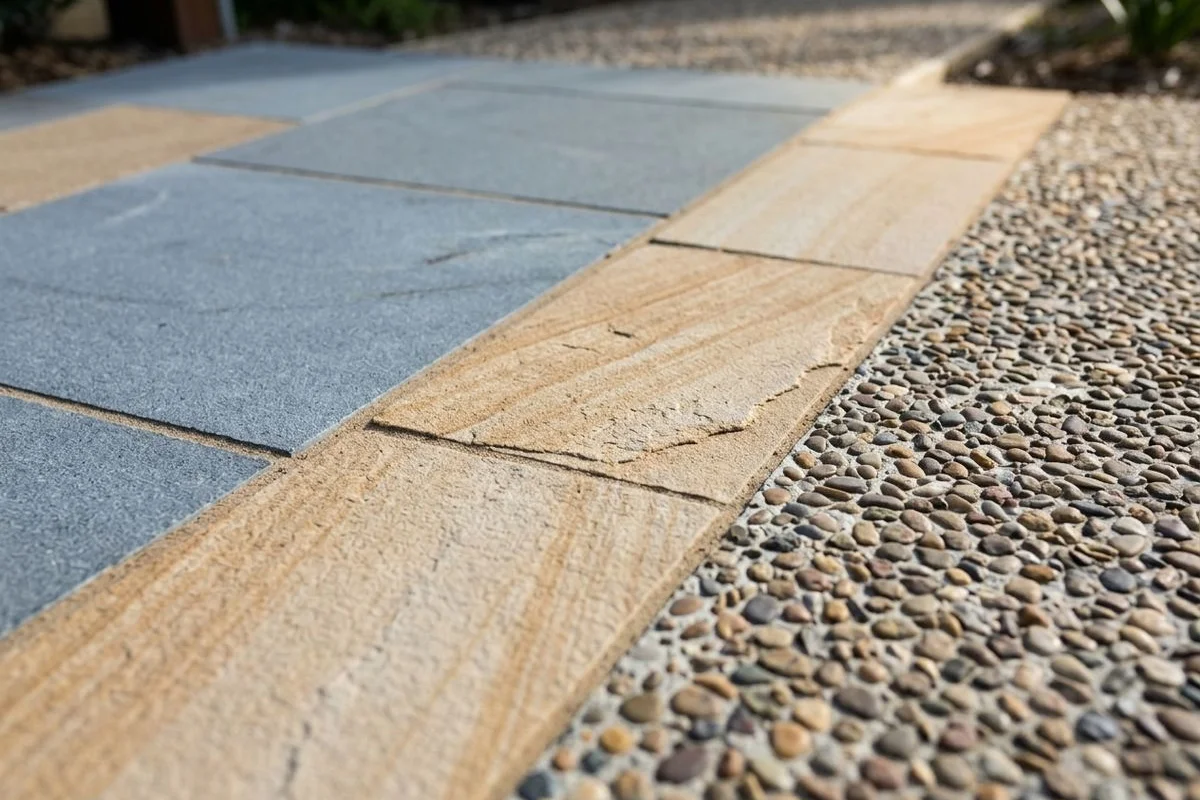
We consider exposed aggregate to be the most practical solution for large, sweeping spaces. The textured surface provides exceptional grip on steep, sloping driveways. A 2026 industry review shows average local costs ranging from $100 to $180 per square metre.
Our concreters mix specific pebbles and stones to match your existing brickwork. This monolithic pour resists the shifting forces of reactive clay soils beautifully. The lack of individual paving joints means weeds have nowhere to grow.
- Cost: $120-$180 per m² installed
- Look: uniform, architectural, variable palette
- Wear: excellent; low-maintenance
- Maintenance: reseal every 5-7 years
- Best for: driveways, large paths, pool decks (with non-slip aggregate)
We always apply an anti-slip additive during the final sealing process around pools. You must reseal the surface every five to seven years to prevent the stones from dislodging. Regular high-pressure cleaning keeps the mosaic finish looking vibrant.
Quick pick logic
We rely on a straightforward decision matrix to match materials to specific property zones. Function dictates form when dealing with heavy vehicles or wet barefoot traffic. Cost efficiency drops sharply if you install the wrong surface in a high-impact area.
Our design consultants recommend viewing physical samples on your property before committing. Sunlight angles and soil types drastically change how a material performs. The comparison table below outlines the clearest choices for common landscape features.
| Application Area | Top Recommendation | Why It Works |
|---|---|---|
| Driveway | Exposed aggregate (cost-effective) or bluestone (premium) | Aggregate handles steep slopes safely. Bluestone offers unmatched 120 MPa strength for vehicles. |
| Pool surround | Bluestone (classic) or travertine (warm, separate category) | Bluestone gives an R11-R13 slip rating. Travertine stays cool underfoot during summer. |
| Entry court | Bluestone for presence, sandstone for warmth | Bluestone creates a formal Victorian feel. Sandstone adds organic charm to heritage homes. |
| Paths and stepping stones | Bluestone or sandstone | Both offer excellent durability for foot traffic. Sandstone hides dirt naturally. |
We coordinate the entire material selection and installation process for a stress-free experience. Proper base preparation prevents the paving from sinking into soft Melbourne clay.
A well-executed installation adds massive curb appeal and functional space to your property.
Our experts recommend taking two specific actions to finalize your landscaping plans:
- Secure a professional site assessment to evaluate your specific soil and slope.
- Explore the full scope of the paving and driveways service, which covers all material families.
We know that getting the foundation right guarantees your new surface will last for decades. The bluestone vs sandstone vs exposed aggregate decision requires careful local analysis.
Contact David Claude Landscape Design today to schedule your consultation.