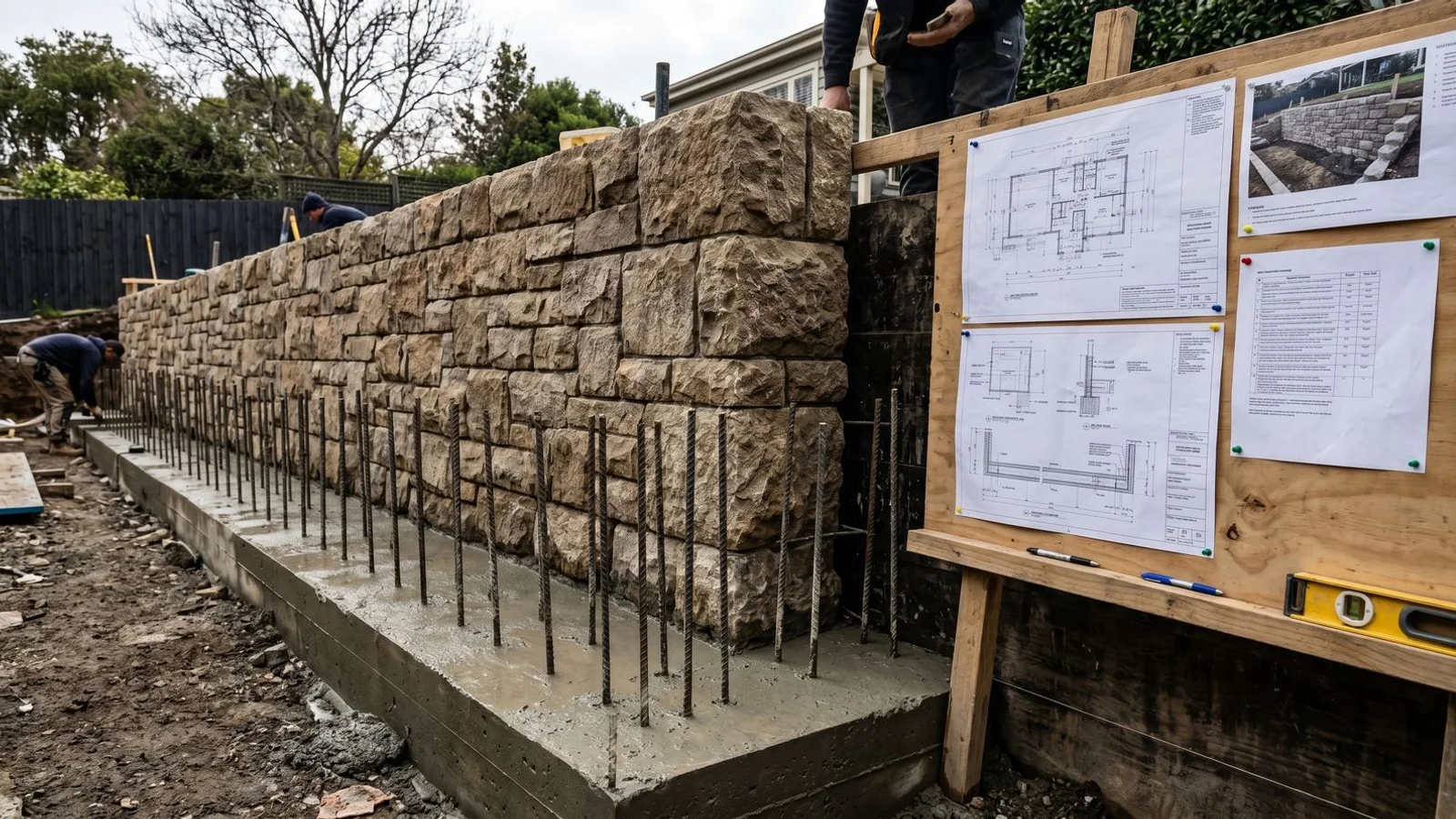
We frequently see property owners treat retaining walls as simple garden edging. The truth is that holding back tonnes of soil carries serious structural risk.
Our design team created this guide to clarify exactly when a retaining wall needs engineering and professional oversight.
Let us review the legal thresholds, the hidden forces acting on your boundary, and the exact steps required for local compliance.
The AS 4678 standard
All structural retaining walls in Australia must comply with the AS 4678 (Earth-Retaining Structures) standard. This strict national code dictates how walls handle earth pressure, hydrostatic forces, and specific soil classifications.
We rely on these guidelines to ensure every wall meets a guaranteed 60-year design life for residential dwellings. Professional engineering documentation proves that a structure can safely withstand these long-term environmental stresses.
The standard specifically mandates calculations for several critical elements:
- Ultimate and serviceability limit states
- Material durability over a 60-year lifespan
- Subsoil drainage requirements to prevent water buildup
- Appropriate safety factors for the specific site conditions
We use these precise calculations to protect your property and your investment.
When engineering is required
Determining the need for an engineer depends on local regulations and specific site conditions. You must secure professional design input if your project triggers any of the specific thresholds listed below.
Height above 1m
Walls taller than one metre from the finished ground line automatically trigger the need for a structural engineer. The Building Regulations 2018 (Schedule 3) apply to any structural retaining wall Victoria residents plan to build, mandating that walls over this height require a formal permit.
Our builders also warn clients that any wall constructed on or near a property boundary requires a permit and engineering regardless of its height.
An engineered design prevents taller structures from leaning or collapsing under massive soil weight. This process protects both your safety and your relationship with adjoining neighbors.
Surcharge loading
A shorter wall measuring just 800mm will still require engineering if it supports a driveway, swimming pool, or building structure. These extra weights are called surcharge loads.
They dramatically increase the horizontal pressure pushing against the wall. We frequently encounter projects where a standard vehicle parking area adds a 5 kPa live load to the surrounding soil.
Here is how different surface uses change the engineering requirements:
| Surcharge Type | Typical Live Load | Impact on Wall Design |
|---|---|---|
| Standard Garden | 2.5 kPa | Standard reinforcement. |
| Domestic Driveway | 5.0 kPa | Requires thicker steel and concrete. |
| Heavy Structures | 12.0+ kPa | Mandates deep, specialized footings. |
Engineers calculate these additional forces formally to ensure the wall materials will not crack under pressure. You will often need heavier steel reinforcement or thicker concrete sleepers to handle these hidden loads safely.
Reactive or difficult soils
Heavy clay, organic fill, or shallow rock profiles drastically change how a wall must be designed. You must secure a retaining wall engineer Melbourne councils trust to correctly specify footings in these conditions.
Our landscape crews regularly deal with highly reactive clay soils across Melbourne’s eastern and north-eastern suburbs. These reactive clays absorb water quickly, which causes them to expand and place immense outward pressure on retaining structures.
“Geotechnical reports frequently show Class H1 or H2 highly reactive clays in Melbourne’s northeast, requiring footings to extend well below the zone of moisture variation.”
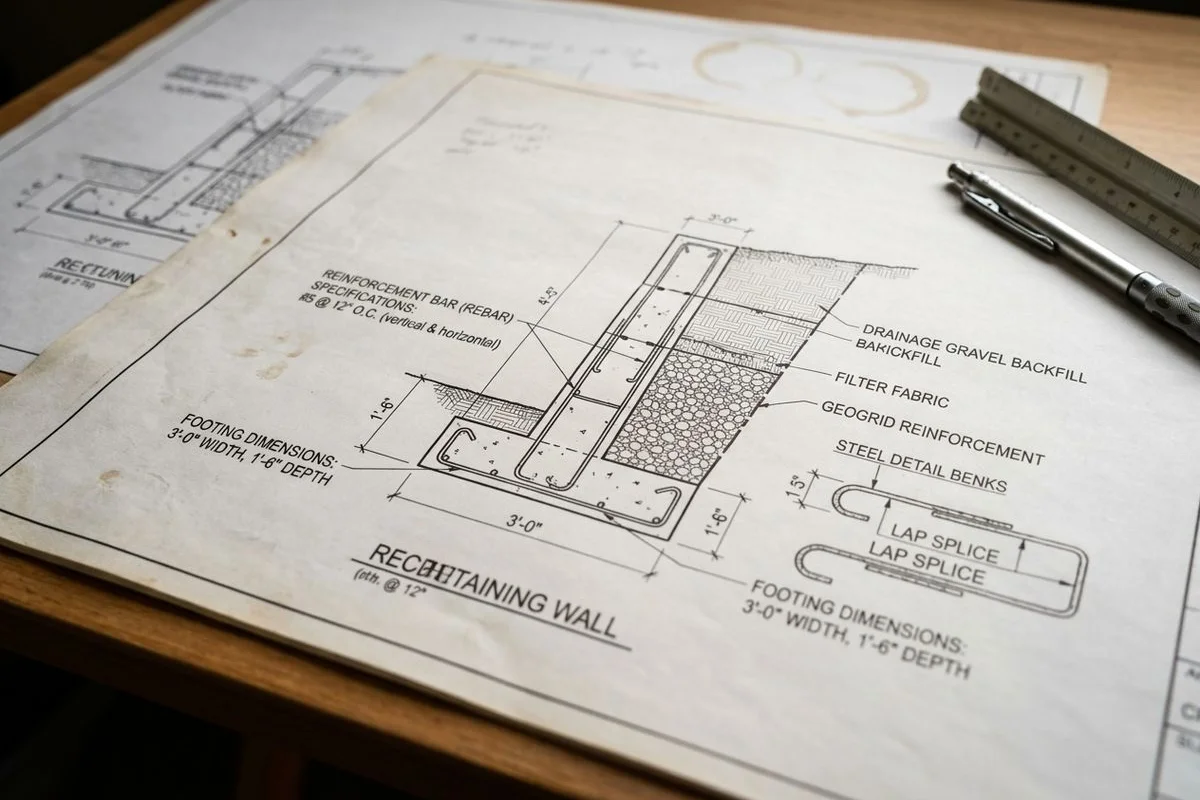
Engineers adjust the design by specifying deeper footings or specialized gravel backfill to compensate for this movement.
Overlay-affected sites
Local planning overlays often force engineering requirements on even the smallest garden walls. A planning review triggered by a specific overlay supersedes standard height exemptions.
We frequently manage projects within Nillumbik Shire where specific property controls apply. Common overlays that trigger engineering assessments include:
- Significant Landscape Overlays (SLO)
- Bushfire Management Overlays (BMO)
- Erosion Management Overlays (EMO)
Council authorities use these engineering assessments to protect mature tree root zones and prevent large-scale soil erosion on sloping blocks. You should always check your property’s specific zoning before assuming a low wall is exempt from permits.
What engineering delivers
An engineering package provides the exact technical roadmap required to build a safe, compliant retaining wall. This documentation replaces guesswork with hard, verifiable data.
Our construction teams rely on these precise specifications to guarantee the structural integrity of the final product.
The final engineering report typically includes these essential components:
- Structural drawings detailing footing depths, 20MPa concrete requirements, and exact steel spacing.
- Load calculations proving the wall can handle a standard 5 kPa domestic surcharge.
- Drainage specifications, such as the placement of 100mm agricultural pipes and weep holes.
- Mandatory inspection hold-points for the building surveyor to verify the steel before pouring concrete.
These documents are strictly required to secure your building permit and pass all final council inspections.
Coordination we handle
We manage the entire structural engineering process directly to save our clients time and frustration. This means you do not have to source quotes, transfer surveys, or play middleman between different professionals.
Our project managers provide the engineer with accurate site data and smoothly integrate their final drawings into the main construction plan. A unified approach typically cuts the standard two to four week engineering turnaround time down significantly. You receive one integrated package that is ready for council submission.
For height-and-permit specifics see retaining wall height limits, or the retaining walls service for the build side.
Conclusion
Understanding when a retaining wall needs engineering protects your property from costly failures and legal penalties. The strict regulations exist to guarantee the long-term safety of your landscape investment.
Our team is ready to evaluate your site and determine exactly what level of professional design is necessary.
Contact us today to schedule a site consultation and receive a clear roadmap for your upcoming project.