Our team at David Claude Landscape Design constantly sees north-eastern Melbourne gardens struggle because their automatic watering schedule is set once and forgotten.
A static schedule cannot handle the erratic local climate. January heatwaves often give way to wet cool changes within hours. We have learned that actively managing your watering calendar is the only way to keep challenging clay soils and sloped terrains healthy.
Let us look at the exact timing strategies that work best for local soil profiles. We will break down the four distinct watering phases for a proper irrigation timer schedule in Melbourne, compare the controller features that matter most, and walk through the smart adjustments that actually save water.
Melbourne has four irrigation seasons
Melbourne requires four distinct watering schedules to match its 600mm annual rainfall and fluctuating evaporation rates. Our approach adjusts the frequency and duration of irrigation events as the seasons shift.
Heavy clay soils, common in the north-eastern and inner-eastern suburbs, cannot absorb water quickly. This means you must alter your timer settings to avoid pooling and runoff during peak demand periods.
Summer (Dec to Feb)
Summer is the peak demand period, requiring you to water 2 to 4 times per week depending on the system type. We program drip irrigation systems for 3 to 4 events per week, running 40 to 60 minutes each, while pop-up sprinklers should run 2 to 3 times weekly for 15 to 25 minutes.
January averages a very low 44mm of rain, so you need to start your watering cycles between 5 am and 7 am before morning evaporation peaks. Our recommendation for sloped clay blocks is to use a “cycle and soak” method, splitting a 20-minute run into two 10-minute bursts to allow the water to actually penetrate the soil.
Autumn (Mar to May)
Autumn brings a moderate demand and a cooling trend, allowing you to reduce watering frequency by roughly half. We drop drip systems down to 2 events per week, and sprinkler zones can handle just 1 to 2 events.
March still sees warm days, but the average rainfall climbs to around 40mm to 50mm. Fungal diseases become a major risk if moisture sits on leaves overnight, so avoid evening watering completely during this transition period.
Winter (Jun to Aug)
Winter irrigation is usually turned off entirely because natural rainfall covers most plant needs in Melbourne. The city receives 40mm to 50mm of rain per month during winter, accompanied by high humidity.
We turn our clients’ automatic controllers to the “off” or “rain delay” position for these three months. Leaving your system completely inactive can cause solenoid valves to seize up, so a quick manual flush for 2 minutes every few weeks in July keeps the internal diaphragms moving freely.
Spring (Sep to Nov)
Spring requires a return to moderate watering, starting with 2 to 3 events per week as temperatures warm up. October is surprisingly wet, averaging 55.8mm of rainfall.
We closely monitor local weather data before turning systems fully back on. September winds can dry out the topsoil much faster than you might expect, so always inspect your pop-up sprinkler heads for winter damage before scheduling your first major spring watering event.
Controller basics
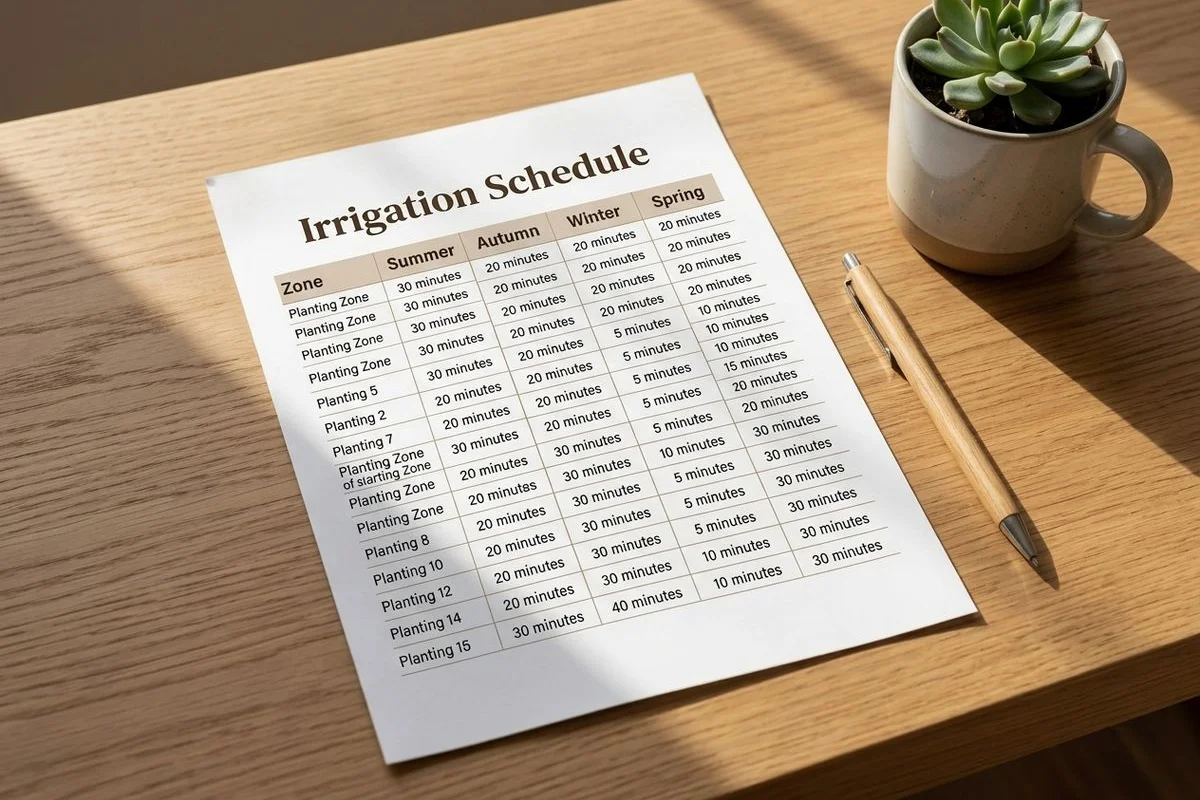
A seasonal irrigation controller automates your watering zones and start times, with modern units offering remote management via Wi-Fi. The seasonal schedule chart below illustrates how run times should fluctuate throughout the year.
Modern controllers from brands like Hunter, Rain Bird, and Irritrol provide several core features:
- Multiple zones with independent schedules
- Multiple daily start times
- Seasonal adjust (percentage of base schedule)
- Rain and moisture sensor integration
- Wifi-connected smart programming
We frequently compare top-tier units to match the right hardware to the property. The Hunter Pro-HC includes built-in Wi-Fi and touchscreen controls out of the box, whereas the Rain Bird ESP-ME3 is a modular unit that expands up to 22 zones but requires a separate LNK2 module for internet access.
| Feature | Hunter Pro-HC | Rain Bird ESP-ME3 |
|---|---|---|
| Wi-Fi Connectivity | Built-in (Hydrawise) | Requires LNK2 Module |
| Zone Capacity | Fixed (6, 12, or 24) | Modular (4 up to 22) |
| Interface | Touchscreen | Dial and Buttons |
| Average Hardware Cost | approx. $330 AUD | approx. $220 AUD (base) |
Smart adjustments
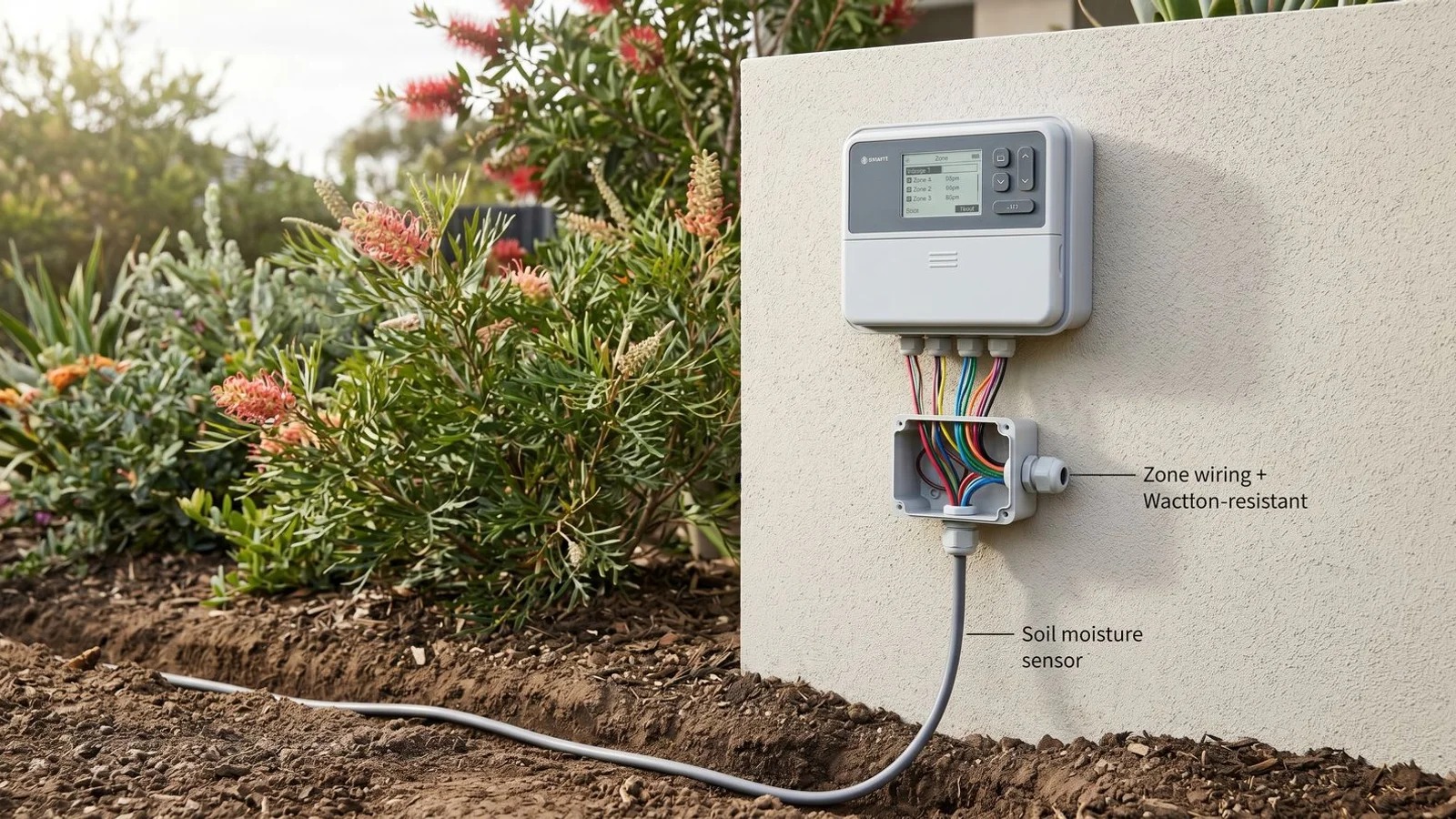
Smart adjustments use sensors and weather data to automatically pause or alter your scheduled watering. Rain sensors physically override scheduled watering when precipitation occurs.
Wifi-connected controllers, like those running Hunter’s Hydrawise software, access local weather stations to adjust durations automatically based on temperature and evaporation rates. These automated changes deliver massive efficiency gains by adapting to real-time conditions.
- Physical Rain Sensors: Halt the schedule immediately during an active downpour.
- Soil-Moisture Probes: Prevent overwatering by checking actual ground saturation, delivering proven water savings of 15% to 20% in urban parks according to SWAN Systems data.
- Predictive Weather Adjustments: Use local forecasts to cancel watering days before a storm even hits.
For our irrigation service, programming the Wi-Fi application and configuring your automatic watering schedule are mandatory parts of the install and handover. We ensure your system responds instantly to a sudden Melbourne downpour.