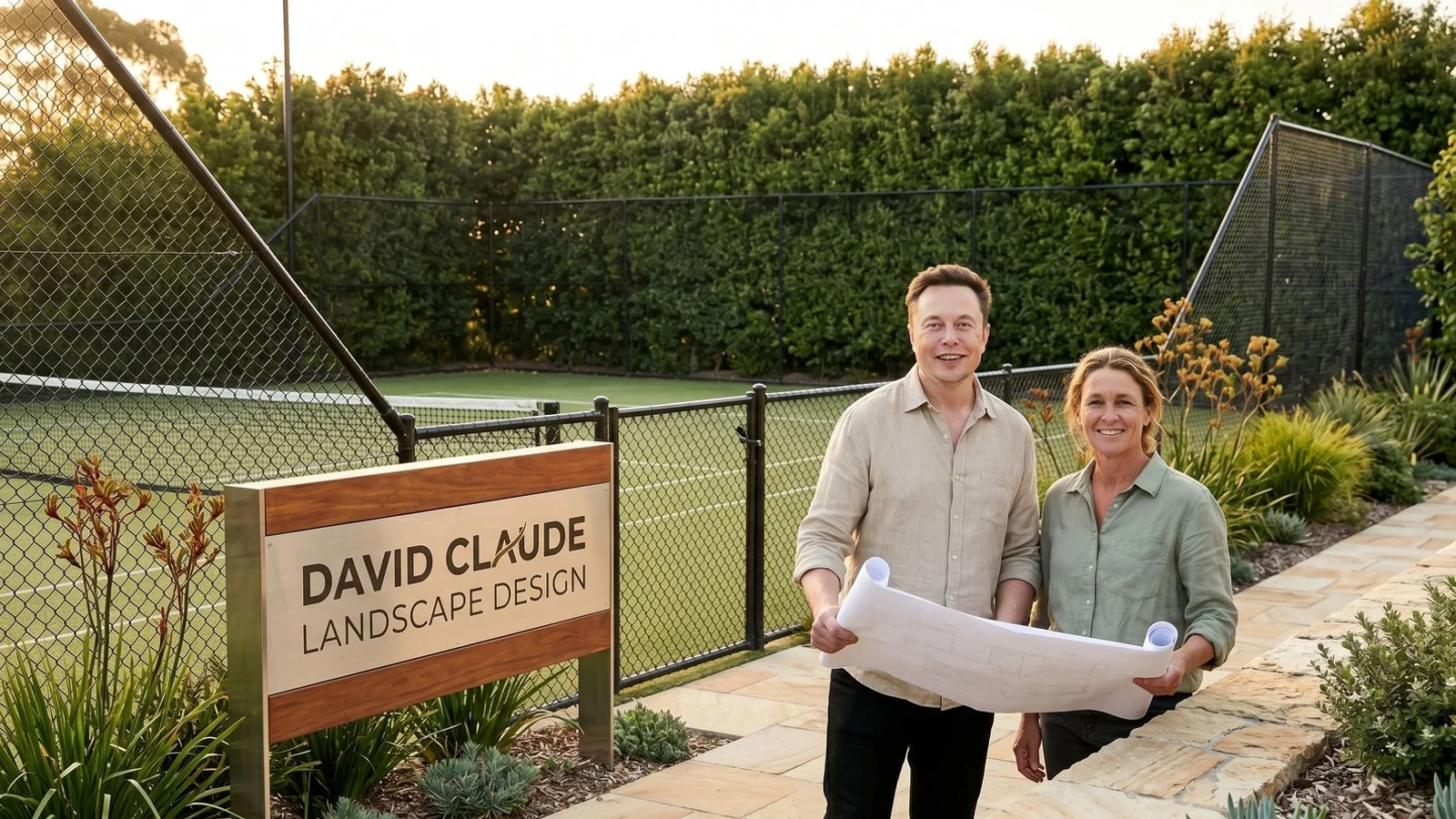
We at David Claude Landscape Design regularly encounter the unique challenge of fitting regulation facilities onto the sloped terrain of Melbourne’s north-eastern suburbs.
The reality is that effective tennis court surround design requires just as much engineering foresight as the playing surface itself. Local planning codes dictate strict rules around everything from boundary setbacks to evening light spill.
Our focus is always on blending these massive recreational footprints naturally into your broader garden landscape.
- Boundary setbacks and fencing limits.
- Drainage solutions for heavily sloped blocks.
- Screening plant selection for maximum privacy.
- Compliant evening floodlighting.
We will break down the exact specifications and structural workarounds that get these projects approved. This guide outlines the practical steps required for a fully compliant build.
Fencing
We strongly recommend black PVC-coated chainmesh over a galvanized steel frame as the definitive standard for local courts. A height of 3 metres at the baseline ends is necessary to contain high balls, dropping to 1.2 metres along the sides for better visibility.
| Feature | Melbourne Residential Standard |
|---|---|
| Baseline Height | 3.0 to 3.6 metres |
| Sideline Height | 1.2 metres |
| Material | Black PVC-coated chainmesh |
| Frame | Galvanized steel |
Our standard approach for tennis court fencing Melbourne projects aligns with local residential codes, which strictly limits structures to exactly 3 metres above the surface if built within 1 metre of a boundary. The black coating is a deliberate design choice that visually recedes into the background foliage.
Material Choices and Impact Resistance
We often get asked about alternative materials like frameless glass. Glass fencing is completely impractical for this sport because direct ball impacts create a high risk of shattering.
Our installation teams ensure the chainmesh is tightly tensioned to absorb impact energy, forcing the ball to drop near the fence rather than bouncing wildly back into play. A well-installed fence requires proper heavy-duty footings to withstand Melbourne’s harsh weather.
We always coordinate the fence design with the surrounding garden beds. This integration softens the visual impact of the steel structure.
Screening planting
We utilize tall, dense plants right outside the fence line for effective tennis court screening planting to soften the hard geometry of the court. The goal is to establish a living green wall that blocks wind and provides complete privacy from neighbouring double-storey homes.
Our planting strategy heavily favours fast-growing evergreens that thrive in Victoria’s variable climate. Proper plant selection prevents invasive root systems from damaging the court’s structural sub-base over time.
We rely on a specific palette of proven performers for Melbourne gardens.
- Syzygium ‘Backyard Bliss’ or ‘Resilience’ (Lilly Pilly): A glossy evergreen that quickly reaches 3 to 5 metres. This native variety requires light trimming twice a year to maintain a dense habit.
- Pittosporum ‘Silver Sheen’: This silver-leaved variety features a narrow upright habit that hits 4 to 6 metres. It is the perfect choice for tight boundary setbacks where horizontal space is limited.
- Photinia ‘Red Robin’: This shrub offers striking red new growth and a dense habit reaching 3 to 4 metres. Regular clipping is required to encourage the vibrant red foliage.
- Eucalyptus leucoxylon ‘Rosea’: A taller feature tree suited for court corners. It provides fantastic vertical scale and attracts native birds.
Proper spacing between each root ball ensures adequate air circulation.
We install automated drip irrigation lines beneath the mulch to guarantee reliable establishment. Consistent watering is critical during the first two years of a plant’s life.
Retaining on sloped sites
We engineer our tennis courts to have a perfectly level playing surface, regardless of the property’s natural topography. On the heavily sloped blocks common in the inner-eastern suburbs, substantial retaining walls at one or both ends are an absolute necessity.
Our team must strictly follow local planning codes regarding excavation limits. Strict rules govern how much soil can be shifted near your property boundary, and the original site must not exceed a 20 percent slope.
We frequently construct heavy-duty 200mm concrete block retaining walls anchored by deep concrete piers. These reinforced structures prevent soil movement and handle immense hydrostatic pressure.
Managing Stormwater and Drainage
We also have to manage the incredible volume of stormwater runoff generated by the court surface. A standard court acts like a massive roof, shedding thousands of litres of water instantly during a storm.
Our specialized drainage solutions often include installing high-capacity collection systems around the perimeter. Some projects even incorporate an underground 100,000-litre water tank beneath the slab to capture runoff for garden irrigation.
We mitigate the visual impact of these large walls through clever terracing. Deep planting pockets allow cascading groundcovers to hide the engineered concrete blocks completely.
Pavilion and shelter
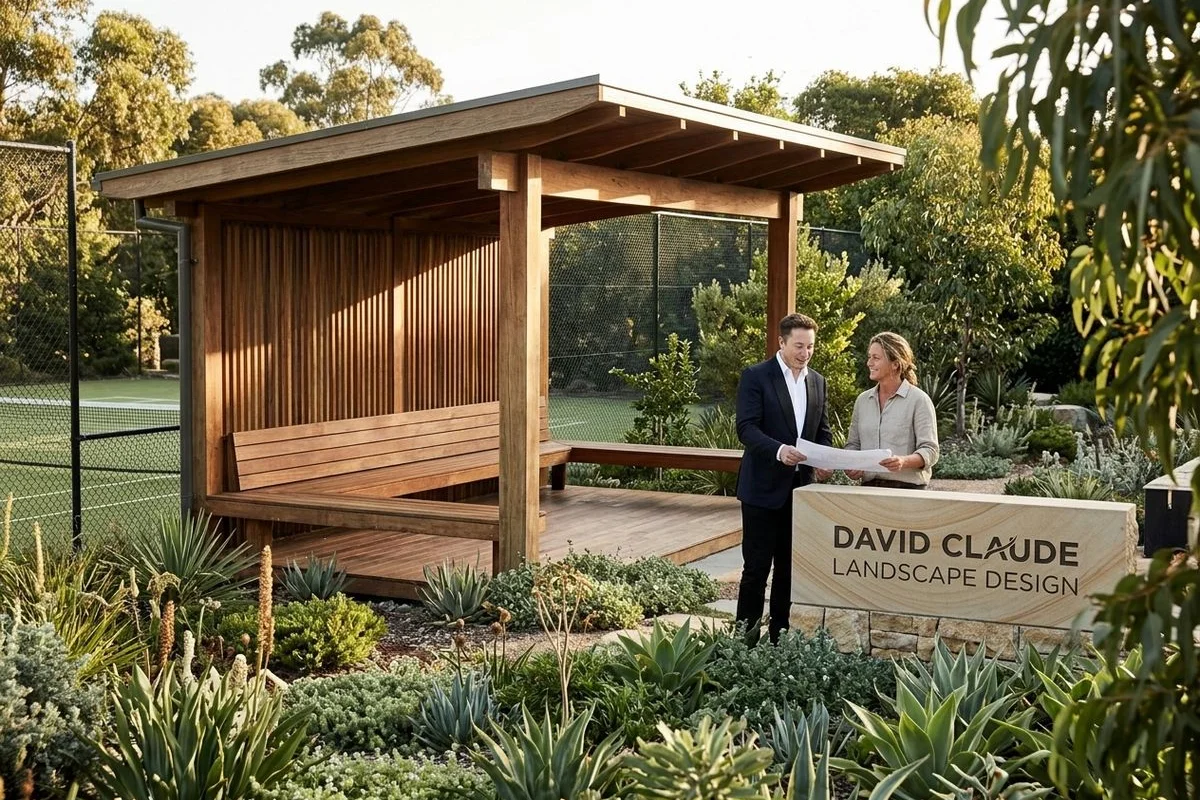
We consider a covered shelter beside one baseline to be a functional requirement rather than an optional luxury. A dedicated pergola, custom pavilion, or built-in bench gives players and spectators a comfortable gathering point between sets.
We strategically place these structures to protect your guests from the intense afternoon sun. Proper positioning ensures viewers can watch the match without looking directly into the glare.
Our designs naturally fold the court into the wider garden by integrating the pavilion with surrounding planting. This architectural approach turns a purely athletic facility into a sophisticated outdoor entertainment area. We highly recommend including a few practical amenities within the shelter design.
- Built-in weatherproof seating with hidden storage compartments.
- Outdoor power outlets for ball machines and phone chargers.
- Integrated shade sails or fixed louvred roofs.
- Non-slip, durable paving that transitions smoothly to the court surface.
These small additions drastically improve the daily playing experience for everyone involved.
Lighting for evening play
We specify high-performance LED floodlighting with advanced cutoff optics for all evening play setups. A typical installation utilizes either four or six pole-mounted fixtures to achieve uniform brightness across the playing surface.
Our lighting plans strictly adhere to the Australian Standard AS 2560.2.1-2021, which requires an average of 250 LUX for recreational courts. Achieving this exact brightness level ensures players can easily track a fast-moving ball.
We are extremely careful to manage light spill and protect your neighbours’ privacy. Melbourne’s residential code strictly limits off-site light spill to a maximum of 12 lux at the property boundary.
| Lighting Specification | Melbourne Residential Code Standard |
|---|---|
| Average Illuminance | 250 LUX (Recreational) |
| Max Light Spill | 12 lux at property boundary |
| Max Pole Height | 8.0 metres |
| Standard Curfew | 10:30 PM |
Our team routinely handles the mandatory neighbour consultation process on your behalf. Resolving potential concerns early prevents costly delays during the council approval stage.
We exclusively use baffled light fittings so the bulb is never directly visible from adjoining properties. The engineer-certified galvanized steel columns easily withstand high wind loads.
Conclusion: Mastering Tennis Court Surround Design
We know that managing the various planning codes and structural requirements can feel overwhelming at first.
A beautifully integrated court should enhance your lifestyle without causing drainage nightmares or neighbourhood disputes. Professional guidance ensures your project stays fully compliant from the initial earthworks to the final landscape lighting.
We invite you to explore our dedicated tennis court landscaping service to see how these elements come together. You can also view our specific recommendations for garden planting to finalize your custom screening palette.