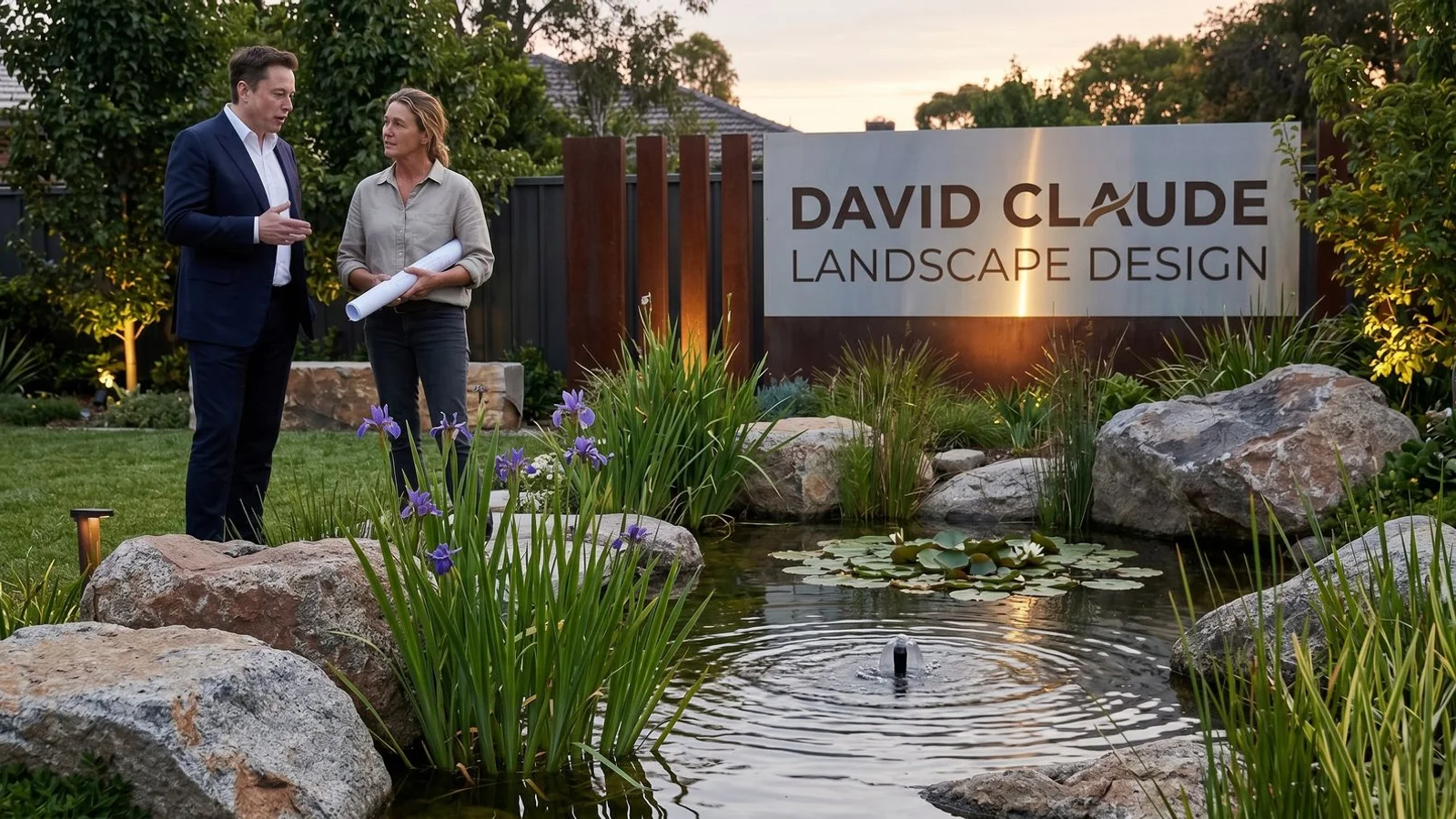
We often see beautifully planned backyards completely derailed by a struggling water feature. For a successful garden pond design, Melbourne properties across the north-eastern and inner-eastern suburbs face extra challenges like steep slopes and heavy clay soils.
The key takeaway from the data is that a stable ecosystem relies entirely on oversizing your initial infrastructure.
Our team at David Claude Landscape Design approaches these projects with a focus on long-term resilience. Let’s look at the core principles of constructing a resilient system, followed by the exact upkeep schedule that keeps it thriving.
Pond design basics
Getting the structural foundation right dictates whether you will spend weekends enjoying the garden or battling algae. Our design philosophy prioritises sufficient water volume and premium materials to create a self-sustaining environment.
Size and depth
A depth of at least 600mm is the minimum requirement for biological stability. Shallow water heats up rapidly during a Victorian summer, cools too fast in winter, and struggles to support healthy fish.
We always remind clients that larger volumes are inherently more stable and need significantly less hands-on care per litre. You must balance this biological need with local municipal safety regulations. Melbourne council pool safety laws typically mandate secure fencing for any water body deeper than 300mm.
Our preferred workaround for the terraced blocks of the inner-east involves installing a heavy-duty submerged safety grate, which allows you to meet strict codes without ruining the visual appeal.
Liner choice
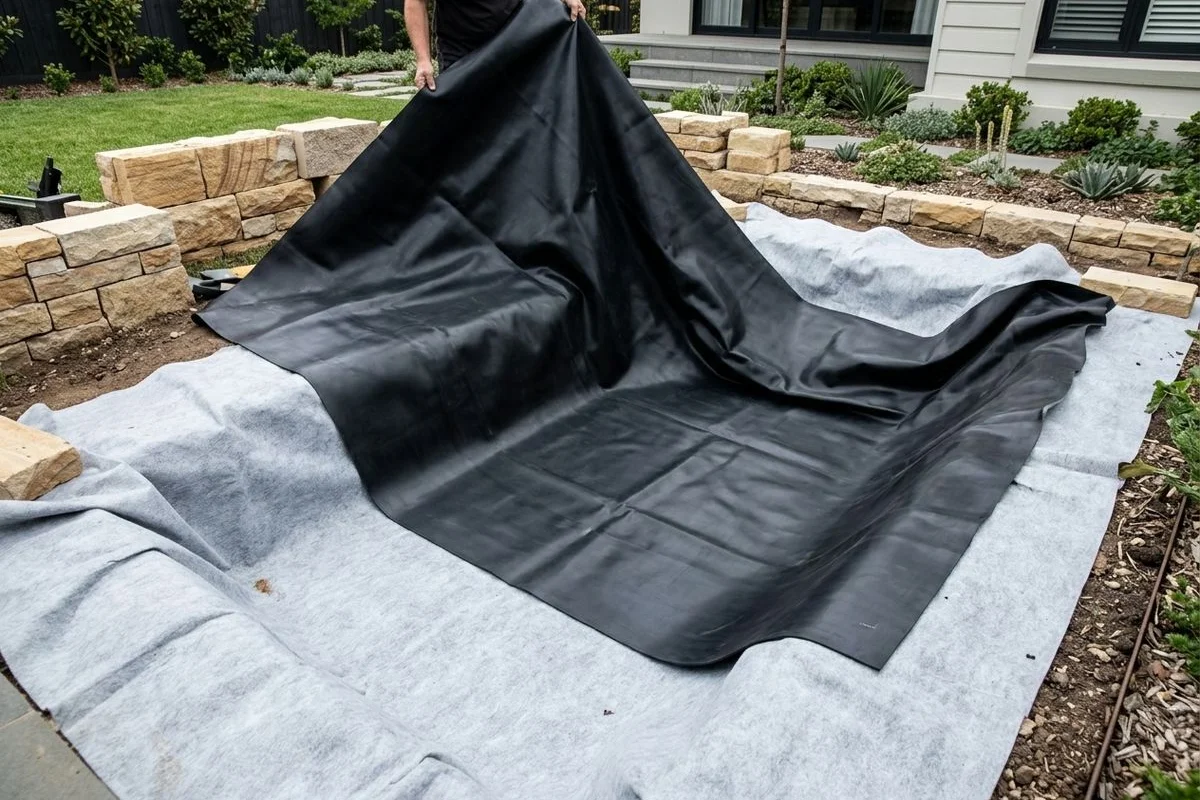
The right membrane prevents costly leaks on difficult, sloping terrain. For your pond liner, EPDM rubber installed over a protective sand-and-underlay bed is the standard for custom-shape excavations.
We install a 1mm thickness for most residential applications, while 1.5mm is necessary for high-traffic zones or heavy rock placements. Firestone PondGard at 1.02mm thickness is widely considered the industry benchmark in Australia.
Our recent supplier checks put the price around $25 to $36 per linear metre for this premium material. This investment provides exceptional puncture resistance against sharp clay soils, guaranteeing a functional lifespan of 20 to 30 years.
Pump and filtration
Moving water efficiently is the absolute secret to a crystal-clear feature. We recommend sizing your pump to circulate three to ten times the total liquid volume every hour. A mechanical pre-filter and biological media handle the primary waste loading.
Oversizing this filtration hardware is the single best predictor of low-maintenance operation. Our technicians install high-performance models like the German-engineered Oase AquaMax Eco Premium 5000 for this exact reason.
These specific units consume a mere 10 to 35 watts of power while automatically adjusting flow based on seasonal temperatures. Selecting an energy-efficient pump dramatically lowers running costs. To keep electricity bills down while maintaining clarity, ensure your hardware includes:
- A variable-flow motor design
- Frost-proof housing rated down to -20 degrees Celsius
- Capability to process coarse debris up to 11mm
- A secondary inlet for attaching a surface skimmer
Planting
Strategic greenery does the heavy lifting for natural water filtration. Our landscape architects heavily favour resilient Australian natives that handle fluctuating local rainfall.
Marginal varieties soften the edges, oxygenators live in the water column, and surface floaters provide essential shade for algae control. You can create a stunning, ecologically balanced system using local species.
| Plant Role | Recommended Native Species | Key Benefit |
|---|---|---|
| Marginal (Edge) | Nardoo (Marsilea drummondii) | Tolerates shallow mud and extended dry spells |
| Oxygenating | Water Milfoil (Myriophyllum simulans) | Provides fish habitat and clears the water column |
| Surface Floating | Running Marsh Flower (Villarsia reniformis) | Yellow blooms aggressively compete with algae for nutrients |
Maintenance routine
Mastering these pond maintenance basics prevents total aquatic system crashes. Our schedule is specifically structured to manage the heavy autumn leaf drop typical of leafy eastern suburbs.
Keeping organic matter out of the water prevents dangerous spikes in ammonia. We always advise that a proactive approach is much easier than trying to reverse a severe algae bloom later.
Here is the exact schedule required for optimal clarity:
- Monthly: Check the pump intake, clean the mechanical pre-filter, and remove floating debris.
- Seasonal: Net out fallen autumn leaves, trim dead aquatic foliage, and test basic water chemistry.
- Annual: Perform a 20 percent partial water change and execute a full filter media rinse using bucketed pond water.
- Every 2 to 3 years: Conduct a larger basin vacuum, divide overgrown edge plants, and refresh the root substrate.
A thoughtfully planned aquatic ecosystem should improve your backyard lifestyle, not add another chore to your weekend list. We highly recommend mastering these core concepts before buying any materials.
Sourcing quality hardware early saves countless hours of frustrating troubleshooting down the road. Our dedicated team is always ready to assist with complex installations or intensive seasonal resets.
For the water features service, simply book an appointment online to get started. If you need help refining your garden pond design, Melbourne residents can reach out today to start planning the perfect backyard oasis.